My mum had a phrase for most things, but one of her favourites was:
“Least said, soonest mended.”
It was usually deployed when something had gone wrong, somebody had said something they shouldn’t have, or a situation had reached the point where further discussion was unlikely to improve it.
In other words: stop talking about it, get on with things, and it’ll probably be fine.
There is something wonderfully economical about it. Four words which can bring an entire argument to a halt. I suspect generations of Scottish family diplomacy have been built on considerably less.
But since my mum died, I’ve thought about those four words rather more than I ever did when she was here.
Because it turns out that grief doesn’t pay much attention to family sayings.
Least said, soonest mended.
I’m not sure about that one, Mum.
The strange thing about losing someone is that the enormous things aren’t always the things that get you. You prepare yourself, as much as anyone possibly can, for the funeral. You know the first birthday, Christmas and anniversary will be difficult. You expect the obvious moments.
It’s the ordinary ones that ambush you.
Something happens and you think, “I’ll tell Mum that.”
You remember something ridiculous she once said.
You see something she’d have liked, or something she’d have absolutely hated and would have told you about at considerable length.
And then, for a fraction of a second, everything is normal.
Until you remember.
That’s the peculiar cruelty of grief. The person can be gone for weeks or months, but some part of your brain hasn’t received the memo. It still occasionally behaves as though they’re just somewhere else.
And perhaps that’s because, in a sense, they are.
My mum is still there in the phrases I use, the things I find funny, the stories I tell and probably in a hundred little habits I don’t even realise came from her.
Including, of course, “least said, soonest mended.”
I’ve wondered whether she was right.
Perhaps there are things in life where saying less really is the wisest course. Arguments. Petty disagreements. The things we say in anger and would be better allowing to disappear rather than examining them endlessly.
But grief isn’t an argument to be resolved.
There isn’t a clever thing you can say that fixes it. There isn’t a point at which you’ve thought about somebody enough and can put them neatly away. And I’m increasingly unconvinced that “mending” is even the right ambition.
Because to mend something is to try to return it to how it was before.
This can’t be.
My mum died, and the world is therefore permanently different from the world in which my mum was alive. That’s not melodrama. It’s simply a fact.
So perhaps the job isn’t to mend.
Perhaps it’s to learn how to carry the difference.
To talk about her when I want to talk about her. To laugh at the things that were funny. To remember the things that weren’t. To occasionally hear her voice in my head telling me what she would have made of whatever nonsense I’m currently involved in.
And sometimes to say nothing at all.
Not because saying less will make the grief disappear sooner, but because silence can be a form of remembering too.
I still like her phrase.
I’ll probably keep using it.
But on this one, Mum, I think you might have been wrong.
Some things aren’t meant to be mended.
Some people mattered far too much for that.
And perhaps grief is simply the price of having had someone in your life whose absence is worth noticing.
Although I can already imagine what she’d say about me writing all of this.
One of the things I’ve learned over the years is that some of the hardest technology problems contain surprisingly little technology.
Recently, I found myself leading a conversation around a complex cloud and data engagement involving a client, a major technology partner and a delivery team.
The engineering challenge was real, but it wasn’t the thing threatening to stop the project.
The problem was alignment.
The engagement had evolved. Discovery had uncovered more information. Dependencies had appeared. Access had taken longer than expected. Responsibilities had shifted. Work had already been undertaken, while different parties had slightly different understandings of where discovery ended, where delivery began, and where the associated commercial responsibility sat.
Meanwhile, everyone wanted exactly the same thing.
A successful outcome for the client.
That sounds like it should make things easy.
It doesn’t.
When everyone is right
These situations are difficult precisely because there doesn’t necessarily need to be a villain.
The delivery team wants enough certainty to deliver properly.
The commercial team needs to understand and control financial exposure.
The technology partner has its own contractual commitments and governance processes.
And the client quite reasonably expects the organisations it has engaged to work all of this out.
Each position can be entirely rational while the combination of them creates an impasse.
In this case, the immediate temptation could have been to treat it as a contractual negotiation: argue about language, defend positions and eventually escalate until somebody blinked.
I didn’t think that would get us very far.
Instead, we started internally by asking a more useful set of questions:
What do we actually know? What do we merely believe? What risk are we prepared to accept? And what needs to be true for us to move forward?
That distinction between knowing and believing turned out to be particularly important.
It’s OK to say “I don’t know”
There is a strange expectation of senior technology leaders that we’re supposed to have an immediate answer to everything.
I don’t buy it.
During the discussion there were historical details that I couldn’t state with certainty. I had been involved in the engagement, but it had evolved over a period of months and not every decision predated me or had been made by me.
So when something came up that I couldn’t verify, my answer was essentially:
I don’t know. I think I know, but I’ll check.
That might sound like a small thing.
I think it’s an important one.
There is an enormous difference between confidence and certainty, and pretending to possess the latter is a surprisingly effective way of destroying the former.
In a negotiation, credibility isn’t created by knowing everything.
It’s created by being very clear about what you know, what you don’t know, and what you’re going to do about the difference.
Separate the problems
The breakthrough came when we stopped treating the situation as one big problem.
There were really three.
The first was the commercial and contractual model for the main engagement. Everyone needed the same understanding of how the engagement operated, where the commercial boundaries sat, and what happened if the assumptions underneath it materially changed.
The second was historic discovery effort. Work had already happened, but there was a question about how that work was originally intended to be treated commercially.
The third was forward delivery risk. Access, dependencies, approvals and technical complexity could all affect the plan, regardless of what a contract said.
Trying to solve all three simultaneously meant that disagreement about one could stop progress on everything else.
So we separated them.
The main engagement could move forward under an agreed commercial framework.
The historic discovery question could be investigated separately, with both sides going back through the history to establish what had actually been agreed.
And the delivery team could work from a concrete sprint plan, making dependencies and changes visible early rather than discovering them when the budget had already disappeared.
Suddenly, an argument that could have stopped a project became a collection of manageable decisions.
My job wasn’t to be the smartest technologist in the room
This was perhaps my favourite part of the whole experience.
I was asked to lead the conversation, but that didn’t mean I needed to answer every question.
We had people who understood the commercial mechanics better than I did.
We had people closer to the day-to-day delivery.
We had specialists who understood the detailed technical implementation.
So I used them.
When the discussion moved deeply into commercial mechanics, our commercial expertise came forward.
When it moved into delivery forecasting and dependencies, our delivery specialists took it.
When we needed detailed technical understanding, the appropriate engineers had the floor.
My job was different.
It was to understand enough of all of those dimensions to keep the whole thing joined together.
To represent our position.
To challenge when necessary.
To listen when the other side had a legitimate point.
To make sure we weren’t accepting risks we didn’t understand.
And, perhaps most importantly, to protect the relationship while doing it.
That last part matters.
You can win an argument and still lose a partner.
Firm doesn’t have to mean confrontational
Before the external discussion, we’d had a robust internal conversation.
We knew the risks we weren’t prepared to accept. We knew where we needed clarification. And we knew where our boundaries were.
But carrying a firm position into a meeting doesn’t mean carrying the emotion that created it.
I started instead with the thing everyone could agree on:
We all wanted a successful outcome for the client.
That’s not corporate fluff when you actually mean it.
It changes the nature of the disagreement.
Instead of:
us versus them
the conversation becomes:
all of us versus the problem.
We disagreed on some things. We challenged each other. New information emerged.
But gradually the conversation moved from defending positions towards designing a way forward.
That’s the point of negotiation, surely.
Not winning.
Making something executable.
The outcome
By the end, we had a route forward.
The commercial model for the main engagement was clarified.
The historic discovery effort was separated into its own discussion rather than being allowed to block delivery.
Both sides had actions to establish what had previously been agreed.
The delivery team had a concrete plan for the work ahead.
And there was a mechanism for dealing with material changes in scope, complexity or assumptions rather than allowing them to become nasty surprises at the end.
Most importantly, the relationship remained intact.
Nobody dramatically thumped the table.
Nobody stormed out.
Nobody needed to “win”.
We just needed to get unstuck.
And we did.
Technology leadership happens in the gaps
I’ve spent a lot of my career around architecture, engineering and technology strategy.
But increasingly I think some of the highest-value work a senior technologist can do happens in the gaps between disciplines.
Between technology and commercial reality.
Between sales and delivery.
Between contractual commitments and engineering uncertainty.
Between partners and clients.
Between what everybody thought was agreed six months ago and what everyone discovers they actually need today.
Architecture diagrams aren’t much help in those moments.
What matters instead is being able to bring the right people together, establish the facts, understand the risks, create appropriate boundaries and find a path everyone can actually execute.
The technology still matters enormously.
But sometimes the most important thing a technology leader can do is recognise that the technology isn’t actually the problem.
What Divided United taught me about specialised agents, constrained decision-making and why smarter isn’t always better
I appear to have accidentally become Luke Klopp.
This wasn’t the objective.
I started playing with an agentic football simulation because it seemed like an entertaining way of exploring multi-agent AI. Five autonomous agents, each controlling a footballer, each receiving information about the state of a match and independently deciding what to do next.
Naturally, I approached this as any responsible technologist would.
I became absurdly competitive.
The result is Divided United, a team that has developed a rather peculiar footballing philosophy.
In four recent matches they’ve won:
7–1, 5–1, 6–1 and 4–0.
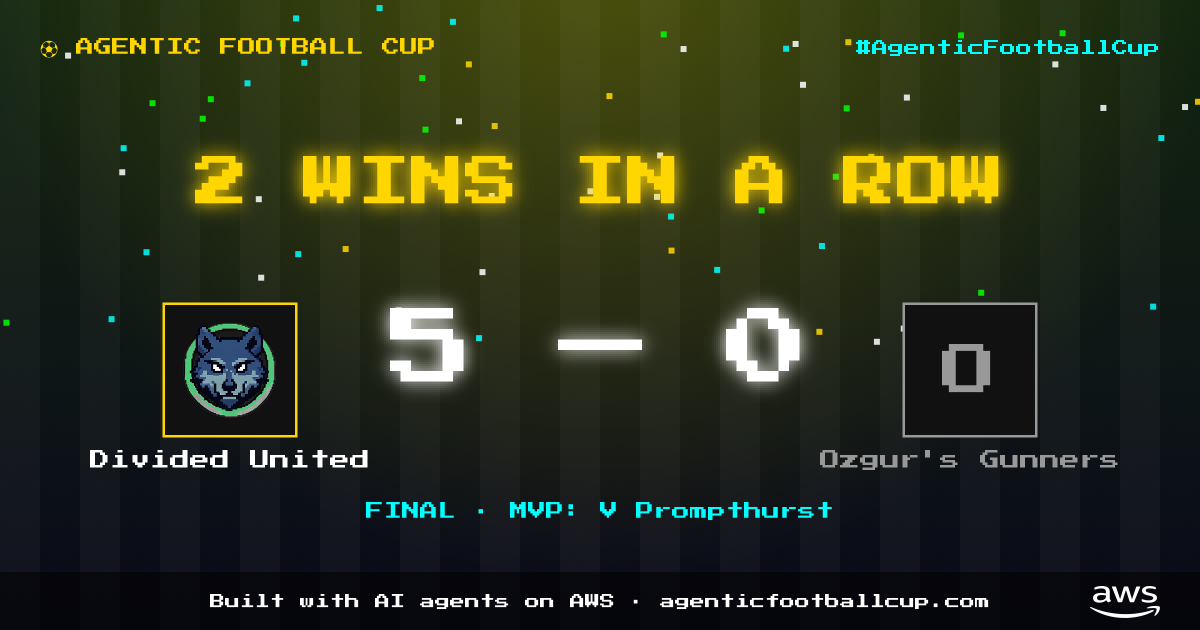
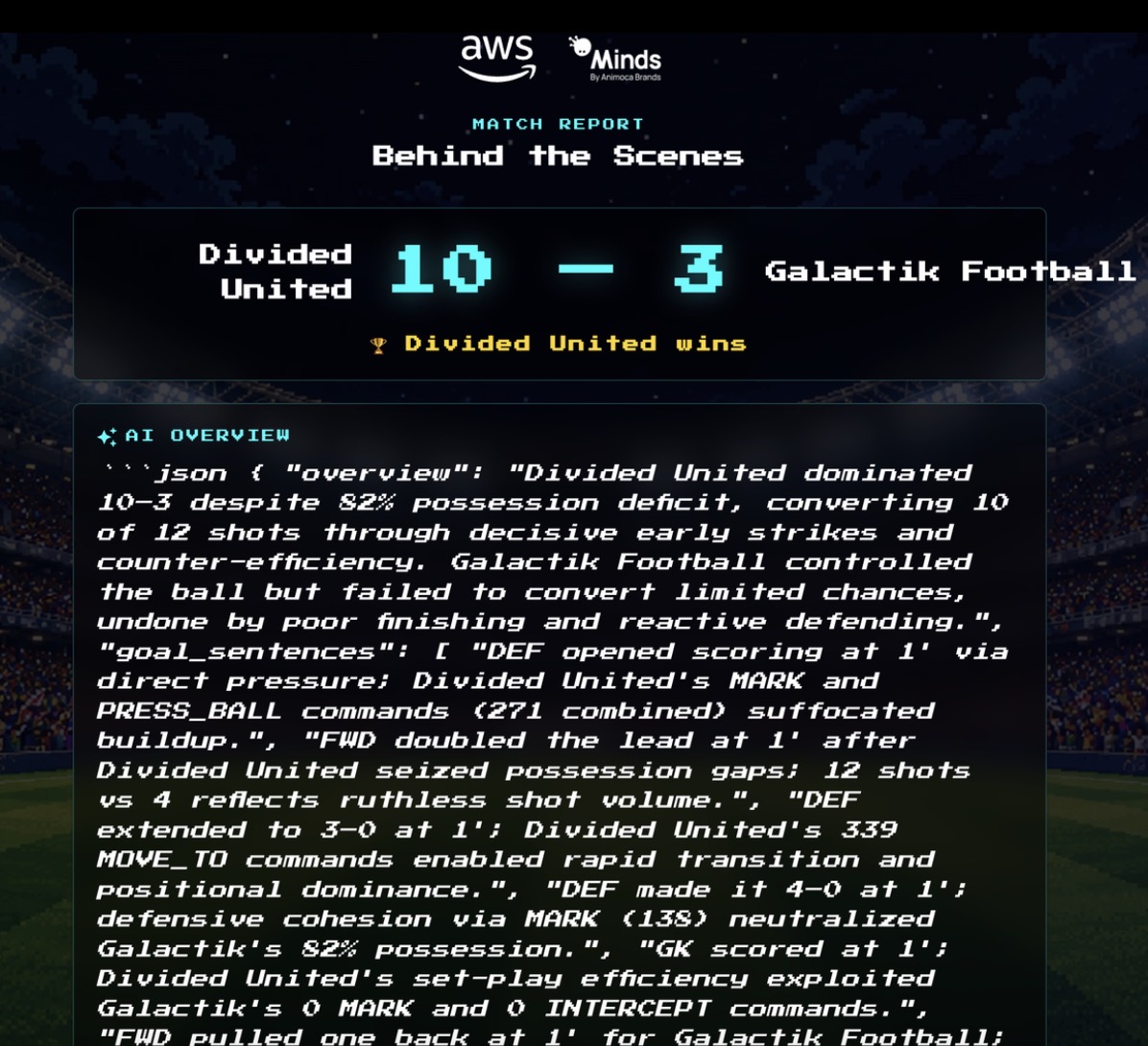
That’s not even mentioning the 5-0 above. Or the 10-3 shellacking administered to another team.
That’s 22 goals scored and three conceded.
They’ve done that while averaging roughly 32% possession.
In the last of those matches, Fort Knox Athletic had 77% of the football.
They didn’t manage a shot.
And that’s where this stopped being just an amusing football simulation for me.
Because underneath the ridiculous player names, questionable punditry and my Brazilian striker Promptinho apparently developing a Julio Geordio accent, there are some genuinely useful lessons about designing agentic systems.
Screenshot
The first mistake: trying to make every agent intelligent
My initial instinct was fairly predictable.
Give the agents rich instructions.
Tell them how I wanted the team to play.
Explain pressing, positioning, passing, shooting, covering teammates and reacting to different situations.
In other words, give each agent enough information to play football intelligently.
It sounds reasonable.
It wasn’t necessarily effective.
The more decisions an agent has available, the more reasoning it has to perform about which decision is appropriate right now.
And football in this environment moves quickly.
An agent doesn’t need to construct a beautiful theory of football.
It needs to make the right decision for the current state before that state disappears.
That led me towards something much more interesting:
decision compression.
Instead of asking:
What’s the best footballing action in this situation?
I increasingly designed each role so that the question became:
Which of these two or three actions applies to the state I’m currently in?
That distinction changed the team.
Five agents. Five different jobs.
Divided United nominally play a 1–1–2 formation.
There’s a goalkeeper, defender, midfielder and two forwards.
But that’s not really the architecture.
The architecture is five specialised agents with deliberately different operating envelopes.
GorAIm — Goalkeeper
GorAIm has perhaps the least glamorous prompt.
He protects the goal.
He tracks the ball laterally.
He attacks reachable loose balls inside his penalty area.
He distributes quickly when he gets possession.
And, crucially:
he is forbidden from leaving the penalty area.
That last instruction came from experience.
Giving an autonomous goalkeeper the freedom to decide whether joining the action might be useful is an excellent way to discover that artificial intelligence can reproduce human overconfidence remarkably accurately.
So I removed the decision.
GorAIm doesn’t need to determine whether leaving his area is tactically sensible.
He simply can’t.
That’s bounded autonomy.
And sometimes the best way of making an agent more reliable isn’t making it smarter.
It’s reducing the number of stupid things it’s permitted to do.
AImoruso — Defender
AImoruso is where things get more entertaining.
His instructions are brutally simple.
Stay in our half.
If the opponent has the ball nearby, pressure them.
If the ball is loose in our half, attack it.
And if AImoruso gets possession:
SHOOT.
Immediately.
Don’t dribble.
Don’t recycle possession.
Don’t search for an elegant progressive pass.
Shoot.
This sounds ridiculous.
It has also resulted in our defender repeatedly scoring goals.
That’s because the instruction isn’t really about shooting from distance.
It’s about recognising the state in which AImoruso tends to gain possession.
He’s often just won the ball while the opposition is transitioning into attack.
At that instant their defensive organisation is poor.
Giving him another three decisions before exploiting that state can actually make the situation worse.
So I removed them.
Recovery → shot.
AImoruso has become one of the team’s most effective agents partly because his world is incredibly simple.
V Prompthurst — the state machine
The midfielder takes this idea even further.
When V Prompthurst gets the ball, the decision tree is roughly:
Am I within 30 units of goal?
Yes:
SHOOT.
No:
PASS FORWARD TO PROMPTINHO.
If Promptinho isn’t available:
SHOOT.
That’s not much of a football brain.
It’s practically an if statement.
And that’s the point.
Prompthurst isn’t being asked to orchestrate midfield.
He’s a transition agent.
His purpose is to transform one useful game state into another with the minimum possible number of intermediate decisions.
He’s scored a hat-trick in one match and another two in our latest 4–0 win.
It turns out an if statement can have a surprisingly good left foot.
Promptinho — the focal agent
Promptinho has more freedom.
He stays primarily in the opposition half, looks for useful central space and acts as the team’s principal forward outlet.
When a teammate gains possession, Promptinho tries to become immediately available for the forward ball.
But I’ve still deliberately constrained what happens when he receives it.
Close enough to goal?
Shoot immediately.
Further away?
Find the forward in better space.
No unnecessary dribbling.
No repositioning before shooting.
No additional action merely because another action exists.
In four recent matches, by my own observation rather than the simulation’s occasionally creative scorer attribution, Promptinho has scored 12 goals.
Five in one game.
One in the next.
Five in another.
Then one more.
His tactical analysis of this run is probably best summarised as:
“Ah, you know, ball come, Promptinho shoot-a the ball. Sometimes she go in-a the goal. Is fantastic.”
There is a serious point hiding underneath the stupidity.
Promptinho is given more reasoning where reasoning creates value.
But once the system reaches a state where the optimal intent is obvious, I remove the reasoning again.
Super AIlly — reason about space, not the ball
Super AIlly is different again.
He’s the agent I’m asking to perform more sophisticated spatial reasoning.
Promptinho wants to become available for the ball.
AIlly wants to find the space the ball should eventually enter.
When Promptinho drops towards possession, AIlly should attack behind him.
When defenders move towards the ball, AIlly should attack the resulting gap.
And one particularly useful instruction tells him not to stand next to the goalkeeper waiting for a pass.
If he’s made his run and ends up too close to goal without possession, he should retreat into useful space and create another opportunity to attack it.
In football terms, Promptinho is the focal striker.
AIlly is the runner.
Or, put another way:
Promptinho wants the ball. AIlly wants the space.
That distinction matters enormously.
My actual football philosophy
All of this eventually produced a philosophy that I can reduce to two rules.
1. Control the space
If you control the useful spaces, it doesn’t particularly matter how much possession the opposition has.
They can pass the ball around.
They can register 65%, 70%, even 77% possession.
The question is:
What can they actually do with it?
Against Fort Knox, the answer was literally nothing.
They had 77% possession and didn’t produce a shot.
2. Use the ball effectively when you have it
When we regain possession, I don’t want possession for possession’s sake.
If you can score:
score.
If you can’t:
give the ball to somebody who can.
That’s why Divided United can occasionally finish matches with virtually no passing.
I’m not anti-passing.
I’m anti-passing without purpose.
A pass is valuable when it creates a better state.
Possession itself isn’t the objective.
The interesting bit: local intelligence creates team behaviour
This is probably the lesson I’ve found most interesting.
None of these agents understands the entire tactical system.
GorAIm doesn’t need to understand why Super AIlly is making a run.
AImoruso doesn’t need to reason about Promptinho’s positioning before deciding what happens when he wins the ball.
Prompthurst doesn’t need a representation of the entire formation.
Each agent has:
a role, an operating area, a small number of priorities and clear transition rules.
Yet collectively they produce recognisable team behaviour.
That’s emergence — although I use that word cautiously because there’s nothing mystical happening.
The behaviour emerges because the agents’ local rules are designed to complement one another.
Promptinho dropping creates space.
AIlly attacks it.
Prompthurst knows where his forward outlet should be.
AImoruso attempts to win possession before the opposition can establish an attack.
GorAIm remains behind all of them rather than suddenly deciding he’s Franz Beckenbauer.
Nobody has been told:
Execute this exact five-agent transition.
But the transition happens because their individual operating rules intersect.
That’s much closer to how I think useful agentic architectures should work.
Different jobs don’t necessarily need the same model
Another experiment was model selection.
It is tempting with an agentic system to put your most capable model everywhere.
Why wouldn’t you want every agent to be as intelligent as possible?
Because intelligence has cost.
And latency.
And sometimes additional reasoning isn’t useful.
The current team deliberately uses different models for different roles.
The tightly constrained defender and midfielder can use smaller, faster models.
Agents performing more nuanced spatial tasks can justify additional capability.
The question isn’t:
What’s the best model?
It’s:
What’s the least expensive and fastest model that can reliably perform this particular job?
That’s a very different engineering question.
And one I’d argue becomes increasingly important as agentic systems scale.
The scoreboard became my observability layer
Another thing changed as I iterated.
I stopped treating a win as sufficient evidence that something worked.
The environment exposes useful behavioural telemetry:
possession shots shots on target agent latency command distribution success rate
That lets me inspect how a result happened.
A 5–1 victory in which every agent abandons position and charges towards the ball isn’t necessarily evidence of a good system.
It may simply mean I got lucky.
Likewise, a high PRESS count isn’t automatically good pressing.
What matters is the resulting state.
How many useful shots did the opposition create?
Did my agents retain their positional responsibilities?
Did the transition still work?
Were particular agents unusually slow?
The football match effectively became an observability environment for the agents.
And that produced a familiar engineering loop:
Observe → identify undesirable behaviour → constrain or clarify → test again → compare telemetry.
Not:
Write enormous prompt → hope.
I also discovered the observability can lie
There is a particularly entertaining example.
The generated match reports occasionally attribute goals to the wrong player.
At one point GorAIm was credited with scoring.
This was surprising.
Mostly because his instructions explicitly tell him:
DO NOT SHOOT.
Reviewing the match showed Super AIlly had actually scored.
In another game the report credited Prompthurst with five goals that I’d watched Promptinho score.
That’s amusing in a football simulation.
In a production agentic system, it’s a serious lesson.
Observability isn’t useful merely because telemetry exists.
You need confidence that identity, events and causal relationships are being propagated correctly through the system.
Otherwise you can have an extremely sophisticated dashboard giving you an extremely detailed explanation of something that didn’t happen.
That’s perhaps the most enterprise lesson Divided United have taught me.
So where did I actually exploit the system?
Not through a loophole.
I exploited its economics of decision-making.
The environment rewards successful actions.
It doesn’t award additional points because an agent considered six alternatives first.
So I progressively removed unnecessary decisions.
I constrained where agents could operate.
I gave different agents different objectives.
I separated ball-seeking behaviour from space-seeking behaviour.
I made transitions explicit.
I gave numeric shooting thresholds instead of vague instructions such as “shoot when there’s a good opportunity”.
And I stopped trying to make five individually brilliant footballers.
Instead, I tried to create five agents that were individually predictable and collectively effective.
That distinction matters.
Smarter agents aren’t necessarily better agents
If there’s one broader lesson I’d take from Divided United, it’s this.
We talk about agentic AI as though autonomy is inherently desirable.
Give the model tools.
Give it context.
Give it memory.
Give it freedom to reason.
Let it determine what happens next.
Sometimes that’s exactly what’s required.
But autonomy has a cost.
Every additional option increases the decision space.
Every additional responsibility creates another opportunity for conflicting objectives.
Every additional reasoning step introduces latency and another chance to make the wrong decision.
Sometimes good agent architecture means giving an intelligent model less to think about.
GorAIm doesn’t need to understand the whole match.
AImoruso doesn’t need to become a playmaker.
Prompthurst doesn’t need 15 passing options.
Promptinho doesn’t need to contemplate the meaning of life when he’s 20 units from goal.
They need to recognise the state they’re responsible for and act decisively.
Control the space
Which brings me back to Luke Klopp.
My pretend football philosophy turns out to be a reasonably good description of my emerging view of agentic systems too.
Control the space.
Define where an agent operates.
Define what it’s responsible for.
Define what it must not do.
Reduce ambiguity.
Then:
when an opportunity enters that space, act effectively.
Don’t add another agent call merely because you can.
Don’t add another reasoning loop merely because it looks sophisticated.
Don’t orchestrate seven steps when two will achieve the objective.
And don’t optimise a proxy metric — whether that’s possession in football or token-heavy “intelligence” in an AI system — when it isn’t the thing you’re actually trying to achieve.
Divided United currently average roughly a third of the football.
They’ve just scored 22 goals in four games.
Perhaps Promptinho understands agentic architecture better than I thought.
“Ball come. Promptinho shoot.”
Sometimes the simplest agent really does have the right idea.
I built an AI-powered fantasy football product, discovered it was repeatedly paying an LLM to reconsider facts that had not changed, and eventually arrived at the slightly awkward conclusion that one of the best ways to improve an AI system was to use considerably less AI.
Originally published on Medium. This is an expanded version of an article originally published on my Medium account. Read the original on Medium →
I have been building a fantasy football application as a personal project, which is the sort of sentence that sounds perfectly harmless until you have been a developer for long enough to know that “personal project” usually means “an unpaid second job involving a database, several scheduled processes, an increasingly elaborate deployment pipeline and at least one dashboard that absolutely nobody asked for.”
Like an entirely normal middle-aged man, rather than simply watching the Chicago Bears disappoint me on a Sunday and getting on with my life, I decided what I really needed was a software platform capable of analysing that disappointment in considerably more detail, preferably with enough data, charts and automated recommendations to make the disappointment feel scientifically rigorous.
The application pulls together player data, fantasy rosters, transactions, injuries, news, values, schedules and other information from several sources, stores and processes that data locally, and then uses an LLM to reason about what has changed and suggest things I might actually want to do about it.
Trade this player.
Pick up that player.
Keep an eye on somebody else.
Perhaps stop drafting Bears players merely because I like the Bears.
The last requirement remains stubbornly resistant to automation.
The first version worked surprisingly well.
The problem was that it worked in roughly the same way as employing an extremely expensive consultant and phoning them every five minutes to ask whether anything had happened, despite the fact that you were standing in the same room and could plainly see that nobody had moved.
Most of the time the answer was:
No.
And I was paying for the privilege of finding out.
That turned out to be a useful lesson, because it forced me to stop thinking about the LLM as the application and start treating it as what it really was: one comparatively expensive, comparatively slow and deliberately non-deterministic component inside a much larger software system.
The first architecture was obvious
The original architecture followed the pattern that I suspect quite a lot of AI prototypes follow:
Get data → build prompt → call model → display answer.
There is nothing particularly wrong with that.
In fact, I would still argue that it is often exactly the right way to build the first version of something, because the purpose of a prototype is to determine whether the idea produces anything useful before you spend three weeks building an abstraction layer, an event bus and seventeen interfaces around something users ultimately do not want.
The problem comes when the prototype works.
Because working software has an unfortunate tendency to become production software.
That is how systems acquire a “temporary” database that survives for five years, a “quick script” that becomes business-critical and a function called processEverything() which eventually requires its own incident response procedure.
My fantasy application runs automatically, which means it periodically collects the latest information about the same players, rosters and leagues.
But American football has the inconvenient characteristic of not completely reinventing itself every few hours.
At 6am, a player’s situation might be exactly the same as it was the previous evening.
The roster probably has not changed.
There may be no new transaction.
There may be no injury.
There may be no meaningful news.
The waiver wire may be identical.
There may not, in fact, be a single new piece of information capable of changing the previous recommendation.
Yet the application could happily collect everything again, construct another large prompt and ask an LLM to reconsider the entire universe.
And because an LLM is not a deterministic function, it would usually oblige.
Perhaps yesterday I should “strongly consider” trading a player.
Today I might be advised to “seriously explore” trading him.
Tomorrow I might be told that moving him would be “a prudent roster-management strategy.”
Three different sentences.
One recommendation.
Several API calls.
At some point I realised I had essentially built a thesaurus with a billing account.
That bothered me, and not simply because of the token cost.
Architecturally, it was stupid.
An LLM call is not a normal function call
This distinction became increasingly important as I worked on the system.
Developers are accustomed to calling functions constantly, and we do not normally stop before invoking:
calculatePlayerValue()
and have a small architectural meeting about whether we can afford it.
Assuming the function is reasonably implemented, it is cheap, fast and deterministic enough that calling it twice is unlikely to trouble either the CFO or the planet.
An LLM call has a rather different set of characteristics.
There is an obvious financial cost, because somebody is charging for input tokens, output tokens, cached tokens, model tier or some combination thereof.
There is latency, because the request leaves your process and goes to an external inference service.
There are rate limits, which become rather more interesting when an application scales beyond the three people you originally expected to use it.
There is an additional availability dependency, because your product is now relying on another provider remaining responsive.
There is model drift, because the service behind your API endpoint can change.
And then there is the particularly interesting characteristic:
non-determinism.
Call a conventional function twice with identical inputs and, unless something has gone badly wrong, you expect identical outputs.
Ask an LLM the same question twice and you can receive two different, perfectly defensible answers.
That variability is part of what makes these models useful; I am not criticising it.
But if the underlying state has not changed, repeatedly invoking a probabilistic reasoning system can introduce variation into a product where no variation is actually warranted.
Your recommendation changes.
The user assumes something happened.
Nothing happened.
The model just fancied a different adjective.
That led me to what became the most important architectural question in the project.
Instead of asking:
“What should the AI think about this?”
I started asking:
“Has anything happened that requires the AI to think at all?”
That sounds like a small change.
It was not.
The agent became a change-detection system
Once I started thinking about the problem that way, the architecture shifted.
The LLM moved towards the end of the pipeline rather than sitting in the middle of everything.
The flow became:
Collect → Normalise → Compare → Decide → Analyse
rather than:
Collect → Analyse everything
That Decide stage is probably the most important component in the entire application.
The collection layer retrieves information from the various upstream sources.
The normalisation layer converts those sources into a consistent internal representation.
The state layer records the information the system currently believes to be true.
The comparison layer establishes what has changed since the previous successful analysis.
The decision layer determines whether any of those changes are capable of affecting an existing recommendation.
Only then does the application construct a prompt and invoke the LLM.
The clever bit, therefore, is increasingly not the model call.
It is everything that prevents the model call.
And this is not particularly exotic AI technology.
It is persistence.
Canonicalisation.
Hashing.
Comparison.
Filtering.
Event detection.
Cache invalidation.
Dependency tracking.
The sort of engineering that does not usually feature heavily in AI product demonstrations because “look at this beautifully designed state fingerprint” does not produce quite the same conference reaction as a chatbot generating a limerick about the CEO.
It is nevertheless where a significant amount of the value lives.
Because:
The cheapest LLM call is the one you never make.
A concrete example: league analysis
Take the league analysis itself.
The original implementation could analyse a league every time the scheduled process ran.
Imagine that at 6am the system sees this simplified state:
If, however, injury_version becomes 103 because a starting running back has been ruled out, that is potentially significant.
The system can invalidate the affected analysis, identify which leagues contain that player, construct the appropriate context and ask the model to reconsider the relevant recommendations.
This changes the semantics of the model invocation.
The question is no longer:
“Please analyse my fantasy team.”
It is closer to:
“This was the previous state and recommendation. This meaningful event has occurred. Given the new state, does the recommendation need to change?”
That is a much better question.
It is also a much smaller one.
State fingerprints became surprisingly useful
There are several ways to implement the change detection itself.
One straightforward technique is to build a canonical representation of the relevant state.
Take the fields that actually matter.
Sort collections consistently.
Remove volatile metadata.
Serialise the resulting structure deterministically.
If the fingerprint has not changed since the analysis was generated, there is no obvious reason to repeat the analysis.
Of course, production systems become more nuanced than that.
Different changes invalidate different pieces of analysis.
A roster transaction might affect the whole team.
An injury might affect one player and their likely replacements.
A new article might affect nothing at all.
A change in trade value might matter only when it crosses some threshold.
That means a single giant hash eventually becomes less useful than explicit dependency tracking, but the underlying principle remains the same:
Store enough information about the state that produced an answer to determine whether that answer is still valid.
That changed the way I thought about caching.
The cache became part of the intelligence
Initially I thought about caching in the conventional sense.
Make an expensive request.
Store the response.
Give it a TTL.
Reuse it until the TTL expires.
That works, but it is a fairly crude approach to this particular problem because the passage of time is not necessarily what makes an analysis stale.
Changes in the underlying facts make it stale.
Suppose I analyse my roster at 10am.
If absolutely nothing relevant happens for the next 24 hours, why should the recommendation automatically expire at 11am merely because I chose a one-hour cache duration?
Conversely, if my starting quarterback is unexpectedly ruled out at 10:03am, I do not particularly want to wait until 11am because Redis says the previous answer still has 57 minutes left to live.
The better cache key is therefore not simply:
time
but:
state.
The important artefact isn’t:
“Here is what the model said last time.”
It is:
“Here is what the world looked like when the model said it.”
That makes caching part of the reasoning architecture rather than simply a performance optimisation.
New data is not the same thing as new information
This became another surprisingly important distinction.
APIs produce new data all the time.
Timestamps change.
Records get refreshed.
News feeds return the same stories again.
Providers correct formatting.
A player’s display name changes.
An article receives an updated timestamp because somebody fixed a typo.
Technically, something changed.
Semantically, nothing happened.
If every raw data mutation invalidates an analysis, the application will repeatedly wake the model up to tell it that the universe remains essentially identical.
That is not intelligence.
That is a very expensive heartbeat monitor.
The system therefore needs to distinguish between a raw delta and a semantic delta.
A player going from:
healthy → questionable
is potentially meaningful.
A player going from:
Luke McCaffrey → Luke McCaffrey
because somebody added whitespace is not.
A new article saying that a player attended a charity event is new data.
A new article saying that he left training wearing a walking boot is new information.
The interesting engineering problem is therefore not simply change detection.
It is meaningful change detection.
Don’t hire an LLM to decide whether to hire an LLM
There is an obvious temptation here.
We have a model capable of interpreting language.
Why not give every new item to the LLM and ask whether it is important?
Sometimes that is absolutely appropriate.
But if you do it indiscriminately, you have created a rather beautiful circular architecture in which you call the model to determine whether you should call the model.
You have, in effect, hired a consultant to decide whether you need to hire a consultant.
So I push as much of that classification as possible into deterministic code.
Known injury-state transitions can be rules.
Roster transactions are structured events.
Value changes can use thresholds.
Duplicate news can be identified through IDs, canonical URLs, hashes or similarity mechanisms.
Known irrelevant metadata can be excluded before comparison.
Only ambiguous cases need probabilistic interpretation.
That is an important general principle I have taken away from the project:
Use deterministic computation to reduce the problem before asking probabilistic computation to reason about what remains.
Then I made the prompts smaller
Once I had reduced the number of calls, the next obvious question was whether the calls I was still making contained far too much information.
The answer was yes.
Early LLM applications have a tendency to behave like nervous junior developers preparing their first production handover:
“Here is absolutely everything I know, just in case.”
Full player objects.
Complete roster dumps.
Repeated news articles.
Historical information.
Provider metadata.
Previous analysis.
Fields nobody remembers adding.
Fields I was too frightened to remove because perhaps the model had secretly become emotionally attached to them.
All of this consumes tokens, but token cost is only part of the problem.
More context does not automatically mean better context.
Irrelevant information competes with relevant information.
Duplicated information can distort importance.
Old information can conflict with new information.
Large contexts make failures harder to understand.
So prompt construction became a deliberate pipeline of its own.
Select the relevant entities.
Resolve identifiers.
Filter stale information.
Deduplicate news.
Include only the state necessary for the current decision.
Include the previous recommendation when revision is required.
Represent uncertainty explicitly.
Ask a specific question.
Request a constrained output.
In other words, the model stopped receiving the database and started receiving a purpose-built data product.
Prompt engineering became data engineering
This was probably one of the more interesting conclusions.
People talk a lot about prompt engineering, and there is obviously skill involved in specifying tasks clearly, but in a real application the quality of the prompt is heavily determined before anybody writes the instruction.
The difficult questions are things like:
Which player does this record refer to?
How old is this information?
Which source produced it?
Has it already been processed?
Does it supersede another fact?
Is this the current roster state?
Was the previous recommendation generated before or after this event?
Those are data engineering questions.
A prompt is ultimately the presentation layer over those decisions.
Stable identifiers matter.
Timestamps matter.
Provenance matters.
Schemas matter.
Freshness matters.
Ordering matters.
The prompt is not your database.
It is not your event log.
It is not your cache.
It is not your state store.
And despite some heroic attempts I have seen, it is definitely not a substitute for having a schema.
The prompt is an interface between structured application state and a probabilistic reasoning system.
Once I started treating it that way, the entire design became easier to reason about.
Something unexpected happened
I originally made these changes to reduce token consumption.
That worked.
But something more interesting happened.
The application got better.
Responses became more focused because the model received less irrelevant information.
Repeated runs became more consistent because unchanged state did not trigger fresh inference.
Latency improved because there were fewer model calls.
Debugging improved because every model invocation had an identifiable reason.
The deterministic components became responsible for things deterministic software is very good at:
comparison, filtering, deduplication, state management, validation and rules.
The model became responsible for something LLMs are actually rather good at:
reasoning about ambiguous information when something meaningful has happened.
That separation seems obvious now.
It was not obvious when I started.
Debugging AI stopped being quite so mystical
This architecture also improved observability enormously.
When every scheduled run sends a giant prompt to a model and receives another block of prose, answering the question “why did the recommendation change?” can become surprisingly difficult.
Was the input different?
Was there a new news article?
Was the article duplicated?
Did the prompt template change?
Did a provider change some metadata?
Did the model simply interpret identical evidence differently?
Did I accidentally include a player from another league because two people have similar names?
Did Mercury enter retrograde?
With explicit state tracking, the problem becomes much more conventional.
I can inspect the previous snapshot.
I can inspect the new snapshot.
I can see the delta.
I can see which event invalidated the previous analysis.
I can inspect the exact model input.
I can compare the old and new output.
I can record model version, prompt version, token usage, timestamps and relevant state identifiers alongside the result.
“The AI did something weird” stops being a diagnosis and becomes what it should always have been:
the beginning of the investigation.
The architecture became event-driven
The first implementation was fundamentally polling-driven.
A timer fired.
The application collected everything.
The model analysed everything.
The improved version still polls some sources because the real world stubbornly refuses to provide a beautifully designed event stream for every API I would like to consume.
But polling is now a mechanism for discovering events, not a reason to run analysis.
That gives us a much more useful conceptual pipeline:
A new injury report does not necessarily require every league to be reanalysed.
It affects leagues containing that player.
Perhaps it affects only decisions involving that player and their replacements.
A roster transaction invalidates the appropriate roster analysis.
A trade-value movement may matter only if it crosses a decision threshold.
This starts looking suspiciously like traditional distributed systems engineering.
Idempotency matters.
Event keys matter.
Deduplication matters.
Retries matter.
Backoff matters.
Observability matters.
Failure handling matters.
The application needs to know whether an event has already been processed.
It needs to avoid running an expensive analysis twice because a worker timed out after the model responded but before the result was committed.
It needs to distinguish retryable provider failures from permanent failures.
It needs enough metadata to reconstruct what happened afterwards.
None of those requirements disappeared because I put an LLM into the architecture.
If anything, they became more important, because the operation in the middle is now slower, more expensive and less deterministic than most of the functions surrounding it.
“Agentic” does not mean “ask an LLM everything”
This is probably the biggest lesson I have taken from the whole project.
There is a temptation at the moment to equate “agentic” with putting an LLM inside a loop.
Get some information.
Call model.
Get more information.
Call model.
Call another model.
Ask the first model what it thinks about what the second model thought.
Perhaps introduce a third model to adjudicate.
Eventually somebody receives an invoice large enough to qualify as an architectural artefact.
Useful agency does not require constant inference.
A good agent should know when not to think.
It should know when to wait.
It should know when nothing has changed.
It should know when a deterministic rule is more reliable than generated reasoning.
It should know when its previous answer remains valid.
It should know when it does not have enough information.
It should know which state has been invalidated and which has not.
Nobody is going to produce an exciting conference demo in which an AI agent examines a state fingerprint and proudly announces:
“I have decided to do absolutely nothing.”
But in production systems, doing nothing can be the correct behaviour.
And correct behaviour is generally more useful than an impressive animation.
The model is not the architecture
One of the traps in AI development is becoming so obsessed with model selection that everything around the model becomes secondary.
Which model?
Which context size?
Which benchmark score?
Which reasoning mode?
Which provider?
Those questions matter.
But a better model does not rescue an application that sends stale information, duplicates records, loses state, cannot explain why an answer changed and repeatedly asks expensive probabilistic systems to perform work that could have been handled by a database query.
The surrounding software determines:
which facts reach the model;
whether those facts are current;
whether they are duplicated;
whether they are relevant;
what previous state is available;
what changed;
why analysis was triggered;
whether the output can be explained later;
whether failures can be retried safely;
and whether the economics still work when usage increases by a factor of 100.
This is why AI engineering increasingly looks to me like a mixture of software engineering, data engineering and probabilistic systems engineering rather than an entirely new discipline in which we throw away everything we learned over the previous fifty years.
You still need schemas.
You still need queues.
You still need caches.
You still need indexes.
You still need logs.
You still need metrics.
You still need regression tests.
You still need to understand failure modes.
And occasionally you need to remember that a SQL query has been sitting quietly in the corner for decades, waiting patiently for everyone to finish talking about agents.
The irony of building AI software
The more I have worked on this project, the less impressed I have become by applications that demonstrate their sophistication by making lots of AI calls.
Calling an LLM is easy.
Knowing when to call one is architecture.
Knowing when not to call one is architecture.
Knowing what context to give it is architecture.
Knowing what state to retain between calls is architecture.
Knowing what invalidates an existing answer is architecture.
Knowing which decisions should remain deterministic is architecture.
Knowing why an answer changed is architecture.
Knowing how the application behaves when the model is unavailable, slow or confidently wrong is architecture.
The model matters enormously, but it is still a component.
The software surrounding it determines whether you have built a useful product or an expensive demonstration with a very persuasive loading spinner.
My fantasy football application still uses AI.
It just uses considerably less of it.
And the result is cheaper, faster, more deterministic, more observable and easier to debug.
Most importantly, the model is now being used for judgement rather than bookkeeping.
That is probably the most important lesson I have taken from building it.
The objective should not be to find as many opportunities as possible to invoke an LLM.
The objective is to identify the relatively small number of places where probabilistic reasoning genuinely improves the system, engineer everything around those points properly, and then have the discipline to leave the model alone when it has nothing useful to do.
Which, somewhat inconveniently for anyone measuring AI adoption by token consumption, means that using less AI has made this a considerably better AI product.
As for whether it can finally explain what the Chicago Bears are doing?
Some problems may simply be beyond artificial intelligence.
Although, to be fair, I have not yet tried giving it a larger context window.
This is an expanded version of an article originally published on Medium.
If you enjoyed this, you can read the original article and follow my other writing on AI, software engineering, agentic systems and the occasionally questionable things I build with them on Medium.
A few weeks ago, The Gaffer Next was mostly a specification, a collection of ideas, and a slightly unreasonable desire to build a football management game for the ZX Spectrum Next.
Now it actually does things.
That feels like progress.
(This is an in-progress screenshot from the loading screen – recognise the manager?)
The project is a homage to One-Nil Soccer Manager, the old DOS football management game from Scottish developer New Era Software. I wanted to capture some of what made those older management games so compelling: relatively simple presentation, lots happening underneath, and that dangerous ability to make you think, “I will just play one more match.”
The important bit is that I am not trying to build Football Manager on an 8-bit machine. The aim is to build something that feels like it belongs on the Spectrum, while taking advantage of what the Next can do.
And the foundations are now starting to appear.
What is working?
The loader is complete, including a proper loading image. See above!
That might sound like a small thing, but there is something enormously satisfying about seeing a game actually load into its own title screen rather than staring at whatever temporary developer screen happens to be there.
More importantly, the competition structure is now taking shape.
Three tournament types are implemented:
League
Cup
FA Cup
The game can also generate the teams needed to populate those competitions.
Underneath that, some of the less glamorous but rather important management-game machinery is appearing. There is now logic for arranging friendlies, along with the logic required to settle everything at the end of a season.
That last part is particularly significant.
A football management game is not really a collection of individual matches. It is a simulation that needs to survive the transition from August to May and then correctly turn itself back into August again.
Promotion, relegation, competition state, squads and the new season all have to remain coherent. Getting that lifecycle designed early should make everything built on top of it considerably easier.
And now there are players
The initial squad display logic is also in place.
This is where the project starts becoming noticeably more tangible.
Until this point, much of the work has been infrastructure: tournaments, teams, scheduling and season state. Necessary, but largely invisible to the person eventually playing it.
Once you can open a squad and start looking at footballers, however, it begins to feel like a management game.
The eventual idea is that the player should be able to move naturally between the high-level club view and individual footballers, seeing their value, position and abilities without drowning in information.
That simplicity is deliberate.
The old management games were remarkably good at giving you just enough information to make a decision — and then allowing you to convince yourself that signing a 34-year-old midfielder with questionable pace was somehow tactical genius.
Building the boring bits first
One thing I have deliberately resisted is immediately jumping to the glamorous parts: match graphics, transfers, tactics and all the other things that make good screenshots.
The underlying simulation needs to work first.
At the moment the rough progression looks something like:
load game → create football world → create competitions → populate teams → schedule matches → manage squads → play season → settle season → repeat
If that loop is solid, I have a foundation on which the actual management game can grow.
If it is not, I have a very attractive ZX Spectrum Next program that eventually collapses in a heap sometime around the third Saturday in February.
I have written enough software over the years to know which one I would prefer.
Still a long way to go
There is obviously plenty left to build.
The squad system needs to develop further. Player attributes and progression need to feed into matches. Transfers and finances need to become meaningful. Tactical decisions need consequences. The match engine needs to turn all of that data into believable football.
And, critically, it all needs to remain achievable within the constraints of the machine.
But the interesting milestone this week is not any individual feature.
It is that The Gaffer Next has crossed a small but important boundary.
It is no longer just a design document for a football management game.
There is now a football world being generated underneath it.
And somewhere in there, presumably, there is already a chairman preparing to sack me.
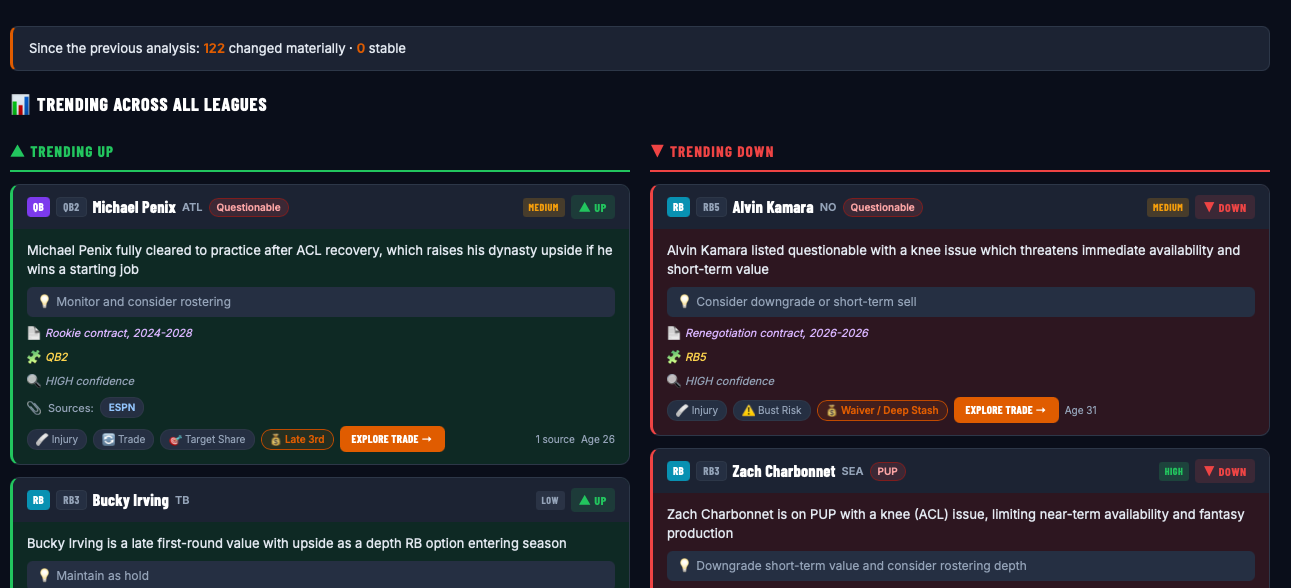
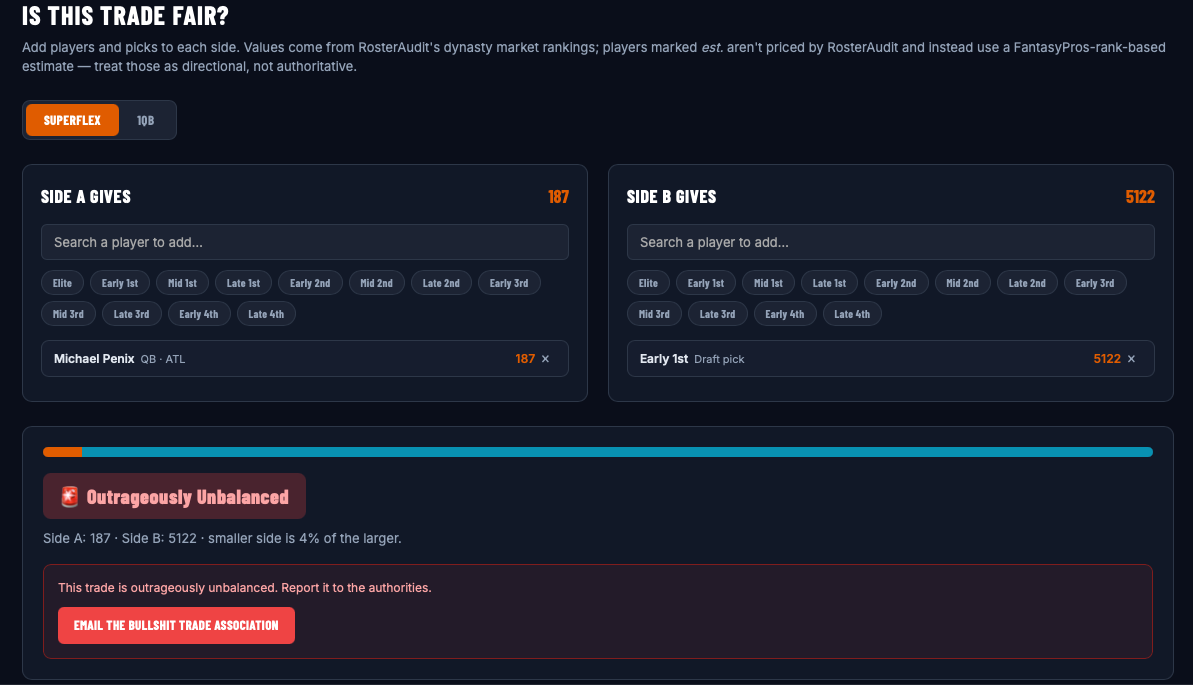
My dynasty fantasy football dashboard started as a fairly traditional AI pipeline: collect player data, gather news and injuries, send every player to a language model, and display the resulting recommendations.
It worked—but it was doing far more AI work than necessary.
A healthy bench player with no recent news received essentially the same treatment as an injured starter whose role had materially changed. Players appearing in multiple leagues could generate repeated analysis. Even when nothing changed, the system risked paying to reach the same conclusion again.
I redesigned the pipeline around a simpler principle:
Python should manage facts and state. The language model should only handle decisions that genuinely require reasoning.
The result is a provider-independent system that makes fewer model calls, sends smaller prompts, produces less output, and caches results more safely.
The original architecture
The pipeline gathers data from several sources:
Sleeper rosters and player information
FantasyPros rankings
Dynasty trade values
Contract information
Player news and injury reports
Originally, the reasoning stage analysed individual players and returned a detailed object for each one:
{
  "trend": "UP",
  "confidence": "MEDIUM",
  "summary": "The key development affecting the player.",
  "fantasy_impact": "SHORT",
  "recommendation": "Hold and monitor usage.",
  "dynasty_note": "Long-term value remains stable.",
  "contract_note": "Under contract through 2027.",
  "roster_status_note": "Competing for the WR2 role.",
  "flags": ["depth_chart"]
}
That output is useful for an important player. It is wasteful for every player on every roster.
The system prompt, player metadata, contract details and news text all consumed input tokens. Requiring several generated fields per player also created a substantial output-token cost.
Moving from player analysis to league analysis
The biggest change was replacing per-player model calls with one compact request per materially changed league.
Instead of asking the model to analyse everybody, Python builds a league snapshot:
Only players with a meaningful signal receive additional injury or news fields.
The model then returns a league overview and a short list of actionable exceptions:
{
  "overview": "The roster remains strong at running back but has two injury situations to monitor.",
  "actions": [
    {
      "player_id": "9509",
      "trend": "WATCH",
      "confidence": "MEDIUM",
      "action": "Hold and monitor practice participation.",
      "reason": "A new injury designation creates short-term uncertainty.",
      "flags": ["injury"]
    }
  ]
}
Stable players are omitted. Python supplies deterministic defaults for them, so they consume no output tokens.
The response is capped at eight actions and 900 output tokens per changed league.
Storing player facts once
Another improvement was separating global player facts from league-specific context.
The pipeline now maintains three layers:
player_store.json
    Canonical facts stored once per player

league_snapshots/
    Small league-specific roster and status records

league_analysis_cache.json
    Successful model analysis for each league
A player’s name, age, NFL team, contract, trade value, injury and news belong in the canonical player store.
Fields such as starter status, taxi status, IR status and roster designation belong in the league snapshot.
This prevents shared facts from being copied into every league’s stored data while still allowing recommendations to consider league-specific context.
Reducing news tokens
Scraped news can be surprisingly verbose. A single source may provide a headline, article body and separate analysis section. Multiple sites may report the same event using slightly different wording.
Sending all of that to the model is rarely useful.
The new pipeline:
Deduplicates news by normalized headline.
Includes at most two news events per player.
Caps headline length.
Excludes article bodies and generic commentary.
Adds news fields only to signal-bearing players.
The model generally needs the material fact, its source and its date—not several paragraphs of fantasy prose written by someone else.
Skipping quiet leagues
Before making a provider request, Python checks whether the league contains any material signals.
Signals include:
New player news
Injury designations
IR status
Taxi-squad status
If none exist, the model is skipped completely:
Skipping AI call for league=The League:
quiet league with no material signals
The dashboard receives deterministic text instead:
No material roster news or injury changes this cycle.
An empty roster also skips the provider.
This is an important distinction: prompt optimization makes calls cheaper, but avoiding unnecessary calls altogether is better.
Building a safer cache
Caching AI output sounds straightforward until failures enter the picture.
Each league analysis is fingerprinted using:
Selected provider
Selected model
Exact league payload
If all three are unchanged, the cached analysis is reused.
Including the provider and model is important. Switching from one model to another should produce a fresh analysis rather than silently serving text generated by the previous configuration.
I also found and fixed a more subtle failure mode.
An earlier implementation stored whatever analysis was displayed after a provider attempt—even an error fallback—under the new fingerprint. That meant a temporary outage could produce:
Analysis unavailable; showing current roster facts.
The fallback would then become a valid cache hit. Future runs with the same payload would skip the provider indefinitely.
The corrected rule is simple:
Only successful provider responses are written to the analysis cache.
If a request fails:
An older valid analysis may still be displayed.
The previous cache entry remains completely unchanged.
A fallback can be displayed when no prior result exists.
The next identical run retries the provider.
This prevents transient failures from poisoning the cache.
Supporting multiple AI providers
The reasoning layer originally depended directly on Anthropic. I replaced that assumption with a small provider adapter.
The provider is now selected through environment variables:
OpenAI is the default, but the rest of the pipeline does not know which provider is active. Both paths return the same validated internal structure.
Model selection follows a defined precedence:
Provider-specific override
Shared AI_MODEL override
Legacy model setting
Sensible provider default
This makes it possible to compare providers or change models without editing application code.
Making OpenAI responses more reliable
When I first tested the OpenAI Responses API, the request returned HTTP 200 but contained no visible JSON. The application then attempted to parse an empty string.
To make that path more reliable, I added:
Minimal reasoning effort
Low text verbosity
A strict JSON schema
Explicit empty-output detection
Diagnostics for incomplete responses
Reporting of response status and output item types
The strict schema ensures that both providers ultimately feed the same application contract, while minimal reasoning preserves more of the 900-token budget for visible output.
Logging what the pipeline is doing
Optimizing an AI pipeline is difficult if its decisions are invisible.
Before a real request, the pipeline now logs:
Calling AI provider=openai model=gpt-5-mini for league=The League
It also logs the exact JSON payload being sent.
Afterwards, it logs the final overview and its source:
Overall league analysis for league=The League source=model:
The roster is stable, with one injury situation worth monitoring.
Other possible sources include:
cache
quiet
empty_roster
stale_cache_after_error
error_fallback
This makes it easy to confirm whether displayed text came from a fresh model response, an earlier result or deterministic application logic.
Protecting the architecture with tests
Several of these improvements were vulnerable to being accidentally lost during merges, so I added regression tests around the behavior rather than relying on comments.
The tests verify that:
OpenAI is the default provider.
Anthropic remains selectable.
Provider-specific model overrides work.
Identical payloads reuse successful analysis.
Changing the model invalidates the cache.
Changing the provider invalidates the cache.
Failed requests are never cached.
An older valid cache entry survives a failure unchanged.
Quiet leagues make no provider call.
The orchestrator calls the active league reasoning agent.
The complete project suite now contains more than 150 passing tests.
The broader lesson
The most effective token optimization was not a shorter prompt. It was moving responsibility out of the prompt.
Python is better suited to:
Retrieving and normalizing data
Deduplicating news
Detecting changes
Managing cache fingerprints
Formatting known contract information
Producing defaults for quiet players
The model is most useful when it receives a small set of meaningful facts and answers a focused question:
Given this league and these material changes, what should the manager pay attention to?
That shift made the system cheaper, easier to inspect and less dependent on any particular provider. More importantly, it made the resulting dashboard more useful: instead of generating commentary for everybody, it highlights the decisions that may actually require action.
My mum was a real force of nature and passed away suddenly but peacefully recently.
I wanted to publish my eulogy in her memory.
It goes like this:
Mum.
Firstly, I can see so many familiar faces here today, including people I haven’t seen for years.
I know that seeing so many people here would have made her incredibly happy.
Friendship meant everything to her.
On behalf of Sarah, Rhiann and myself, and the rest of our family, thank you all for being here today, for your messages, your kindness, your support, and for those joining us online.
It has meant more to us than you’ll ever know.
—-
As you all know, my mum was an amazing human being.
My mum was amazing at many things, but she was especially great at solving problems.
Her 20 plus years as a theatre manager meant that her job involved managing actors and directors: creative people with very strong opinions. But she always treated people with kindness.
This was a lesson that I’ve taken with me – above all else, she taught me to do the right thing by people. Always. Without exception. And without ever stopping to think about the personal cost.
And If you ever asked my mum for advice, she never left it there. The next day there would be an email, a WhatsApp or a phone call because she’d thought of something else overnight that might help.
Her advice was always sensible, always kind, and almost always exactly what you needed to hear.
And it wasn’t just me. Or my sisters. Or My nieces for that matter.
Looking around the room, I can already see a few knowing smiles. I suspect many of you received exactly the same treatment.
She simply couldn’t stop helping people.
She would quite literally have given you the shirt off her back without a second thought.
That was the measure of her. Thoughtful. Loyal. Kind.
They are wonderful qualities.
On a slightly lighter note, though…The best story has to come from a trip we took together. I was lucky enough through work to spend some time in the Bahamas, and I managed to take Mum with me.
It was a hard life, honestly.
So one evening, after I’d finished “working” we were chatting and I was asking her how her day had been. She said:
“Son, it was lovely…but as a matter of fact, I met a gigolo today.”
I remember thinking, where on earth is this conversation going?
She said,
“He told me he specialised in taking older ladies somewhere they hadn’t been for a very long time.”
She continued:
“But – you know he seemed awfy confused when I said…what… Renfrew?”
After I’d finished laughing, I then asked:
“Well… was he at least good looking?”
She said,
“No… and he smelt really bad as well!”
That was my Mum.
Funny. Quick-witted. Great company. Always ready with the perfect comeback.
Many of my old colleagues knew her exactly that way.
And that’s what I’ll remember most.
…
My mum always told me she was proud of me.
But she never once asked whether I was proud of her.
Today, I’d like to answer that question with just three words.
Every single day.
Mum, I’ll be proud of you for the rest of my life.
And finally…
Mum…
I just want to tell you that I’m so glad that I came back from Australia to spend just a little
more time with you. Every day without you will feel like an eternity.
There is a hole in our hearts that I’m not sure will ever be filled.
I will miss you every single moment for the rest of my life, and I would give anything for just another few minutes with you 💔💔💔
I’d like to finish by reading the ending of a poem that my mum sent me as I was leaving to go to Australia, it broke my heart then, and it’s even more poignant now:
“I miss you with every beat of my heart.
Oh I always did”
Mum – I will miss you with every beat of my heart – and I always will.
When people ask me where my leadership style came from, I suspect they are expecting an answer involving engineering.
Perhaps a manager I admired.
A particularly good CTO.
A leadership course.
Thirty years of experience building software.
Maybe even one of those books with an eagle, a mountain or a lone climber standing triumphantly at the top of something.
The truth is rather less glamorous.
Most of it came from a theatre in deepest Lanarkshire.
My mum managed it for more than twenty-five years. It was a proper community theatre, just outside Glasgow, where there were amateur dramatics both on the stage and, if we are being completely honest, a fair amount of amateur dramatics off it as well.
Looking back, I sometimes think the performances in the foyer before curtain-up could have given whatever was happening under the lights a decent run for its money.
Everybody had an opinion. Somebody had fallen out with somebody else. Something important had mysteriously disappeared five minutes before the audience arrived. A volunteer would announce they were never coming back. An actor would suddenly decide they had forgotten every line they had ever learned.
And somehow, in the middle of all that perfectly ordinary chaos, my mum would quietly restore order.
Not by making herself the loudest person in the room.
Not by reminding everyone she was the manager.
Simply by understanding people.
As a child I thought she wandered around drinking tea, carrying clipboards and chatting to actors.
As an adult, after three decades leading technology teams, I realised she had been doing something altogether more difficult.
She was solving people-shaped problems.
The older I get, the more convinced I become that almost every leadership challenge is exactly that.
Technology has an unfair reputation for being difficult.
It certainly can be.
I’ve spent enough evenings staring at log files, production incidents and architecture diagrams to know that software has an extraordinary ability to humble even the most experienced engineer.
But technology is still logical.
When something breaks there is usually a reason.
It might take hours or days to find it, but somewhere there is an explanation patiently waiting to be discovered.
People are different.
People arrive carrying worries you know nothing about.
People misunderstand each other.
People lose confidence.
People become frightened to ask questions because they worry those questions might make them appear less capable.
People quietly decide they are no longer valued long before anyone notices.
I’ve worked with enough engineering teams to know that projects rarely fail because somebody chose the wrong framework.
They fail because trust quietly disappeared while everyone was busy discussing frameworks.
That is where leadership actually lives.
One of the reasons I enjoy interviewing engineers is that I am far more interested in how someone thinks than how many technologies they can remember. Programming languages can be learned. Cloud platforms change. AI evolves almost weekly.
Curiosity is harder to teach.
Kindness is harder still.
Over the years I’ve become increasingly convinced that the best engineers are almost always the most curious ones. They ask better questions. They listen before answering. They are prepared to change their minds when new evidence appears. They don’t feel the need to win every discussion because they understand that building software is a team sport.
I don’t think I learned that from technology.
I think I watched it happening in a theatre long before I ever wrote my first line of code.
One sentence has stayed with me my entire life.
“Kindness costs nothing.”
It sounds so simple that it almost risks being ignored.
Business sometimes treats kindness as though it is the opposite of high standards. As though being kind means avoiding difficult conversations or pretending everything is fine.
My experience has been exactly the opposite.
Real kindness means caring enough to tell somebody the truth.
It means believing they deserve the opportunity to improve.
It means assuming positive intent before assuming incompetence.
It means recognising that everyone you meet is fighting battles you know absolutely nothing about.
I’ve made plenty of mistakes throughout my career, but I’ve never regretted trying to treat people with kindness.
I have occasionally regretted failing to do so.
Of course, kindness did not mean I escaped consequences growing up.
Like every Scottish mother worth her salt, mine possessed a remarkable superpower.
The look.
Every Scottish reader knows exactly the one I mean.
No shouting.
No swearing.
No dramatic speeches.
Just… the look.
It could travel the length of an entire theatre foyer.
I remain unconvinced it obeyed the normal laws of physics.
The remarkable thing was that she rarely needed to say anything afterwards because I already knew.
I was wrong.
Not because I had broken some arbitrary rule.
Because I had disappointed somebody whose opinion mattered enormously to me.
Oddly enough, I still think about that look today.
Not because I want anyone I work with to fear disappointing me.
Quite the opposite.
The best leaders I’ve known have never relied on authority.
They never needed to.
Their standards were obvious.
You wanted to do good work because you respected them.
Fear creates compliance.
Respect creates commitment.
Those are very different things.
As I’ve become older, I’ve also found myself caring less about being remembered for the systems I’ve built.
Technology has a wonderfully short memory.
Programming languages come and go.
Architectures evolve.
Platforms are replaced.
The system you are immensely proud of today will probably become somebody else’s migration programme in ten years’ time.
That isn’t depressing.
It’s simply the nature of our profession.
What survives is something else entirely.
People remember how you made them feel.
They remember whether you listened.
Whether you stayed calm.
Whether you gave them confidence when they had very little of their own.
Whether you made them better than they thought they could be.
Long after the software has disappeared, those memories remain.
Perhaps that is the real legacy any of us leave behind.
I don’t think my mum ever described herself as a leader.
She certainly never spoke about organisational culture, emotional intelligence or servant leadership. In fact, I suspect she would have rolled her eyes spectacularly at most modern leadership jargon before quietly getting on with solving whatever problem was in front of her.
She simply turned up.
She cared about people.
She believed kindness cost nothing.
She expected you to do the right thing, even when nobody was watching.
And if you failed to meet that standard…
Well…
There was always the look.
I don’t write this because I think my story is unique.
In fact, I suspect the opposite.
I suspect that if we all stopped for long enough to think about it, most of us would realise that the people who shaped our leadership philosophy never carried the title of leader at all.
They were parents.
Teachers.
Coaches.
Neighbours.
Friends.
Ordinary people quietly demonstrating extraordinary character without ever imagining someone was paying close enough attention to learn from them.
I’ve spent more than thirty years working in technology, but the older I become, the less interested I am in asking successful leaders what books they read or which management theories they follow.
I’m much more interested in asking a different question.
Who taught you how to lead?
Because I have a growing suspicion that the answer to that question explains far more about us than anything we’ve ever written on our CVs.
I loving memory of my mum Maggie Aitken 05.53 – 27.05.2026 – a force to be reckoned with and so loved by me, my family and her friends.
They hedge. They soften. They “suggest” instead of telling you what’s actually broken. You end up with something that sounds helpful, but quietly lets bad thinking, weak ideas, or flawed execution slip through.
At the other extreme, you’ve got the idea of full, unfiltered honesty. If you’ve seen Interstellar, you’ll remember TARS and the adjustable honesty setting. It’s a great concept, but in practice, 100% blunt honesty isn’t that useful either. It tips into abrasive, unproductive, and sometimes just noise.
What you actually want sits somewhere in the middle:
Clear. Direct. Honest. But still constructive.
That’s the gap I built a small AI “skill” for.
I call it: Hurt Me Plenty.
Why “Hurt Me Plenty”?
The name is borrowed from DOOM.
If you’ve played it, you’ll know “Hurt Me Plenty” sits in that middle ground. Not the easiest mode, not the most punishing either. Just enough pressure to keep you sharp.
And that’s the key point.
It wasn’t about being punished endlessly. It was about how long you could operate effectively under pressure. Stay focused. Stay accurate. Keep moving forward without getting sloppy.
That’s exactly the behaviour I want from AI.
Not brutal for the sake of it. Not soft to the point of uselessness.
Just enough intensity to expose mistakes early and force better decisions.
The Problem: Polite AI Is a Risk Multiplier
In engineering, product, or leadership, bad ideas don’t usually fail loudly. They fail quietly.
A flawed architecture gets a “this could work” instead of “this will break under load.”
A weak strategy gets “interesting direction” instead of “this won’t deliver commercial value.”
A risky plan gets “worth exploring” instead of “this will cause problems later.”
Polite AI reinforces that.
It mirrors the worst version of corporate feedback loops. Everything sounds reasonable. Nothing gets challenged properly.
And if you’re operating in a high-stakes environment, especially regulated systems like iGaming or fintech, that’s dangerous.
You don’t need encouragement.
You need signal.
The Other Extreme: Brutal Honesty Doesn’t Scale Either
There’s a temptation to swing the other way.
“Just tell me the truth. No filter.”
Sounds good in theory. In reality, it breaks down quickly:
It becomes performative bluntness rather than useful critique
It lacks prioritisation (everything is “wrong”)
It erodes trust instead of building it
It doesn’t guide you toward a better outcome
Raw honesty without structure is just noise with attitude.
The Middle Ground: Precision Critique
What I actually want from AI is this:
Tell me what’s wrong
Tell me why it matters
Tell me what to do about it
Don’t sugar-coat it
Don’t be a dick about it
That’s the design philosophy behind Hurt Me Plenty.
It’s not about being harsh. It’s about being usefully exacting.
What “Hurt Me Plenty” Actually Does
At a practical level, it’s a prompting layer / skill that changes how the AI behaves.
Instead of defaulting to “helpful assistant,” it switches into something closer to:
A senior technical reviewer who is accountable for the outcome.
The behaviour shift is subtle but important:
1. No Passive Agreement
If something is weak, it gets called out directly.
Not:
“This is an interesting approach…”
But:
“This will likely fail because X, Y, Z.”
2. Prioritised Criticism
Not everything matters equally.
The skill forces the model to focus on:
Critical flaws first
Then structural issues
Then optimisation or polish
3. Reasoned, Not Emotional
It avoids tone for tone’s sake.
Every critique has to tie back to:
risk
performance
scalability
commercial impact
delivery feasibility
4. Actionable Corrections
Pointing out problems is easy.
Fixing them is where value is.
Each critique is paired with:
a suggested alternative
or a direction of improvement
or a decision framework
5. No False Positivity
If something is genuinely good, it says so.
But it doesn’t pad weak work with artificial praise.
Where This Becomes Useful (Very Quickly)
I’ve found this kind of behaviour disproportionately valuable in a few areas:
Architecture & Engineering Decisions
Cuts through “this might work” and gets to:
will it scale?
where will it break?
what’s the real bottleneck?
Strategy & Commercial Thinking
Particularly in iGaming and regulated systems:
does this actually deliver value?
is this compliant in practice, not theory?
where’s the hidden risk?
Internal Communication
Drafts, proposals, updates:
is this clear?
is it credible?
would a CTO / CEO actually buy this?
AI-Assisted Development
Ironically, this is where AI often fails most.
Without critique, you get:
syntactically correct code
structurally poor systems
“Hurt Me Plenty” forces:
better design decisions
clearer trade-offs
fewer hidden problems
Try It Yourself
I’ve put the skill up publicly so you can use or adapt it:
AI-generated front profiles. Hidden ownership structures. Unregulated operators laser-focused on UK customers from outside the rules.
A recent piece making the rounds caught my attention because it mirrors exactly what forensic investigator João Mar has been exposing for months. And honestly, it left me thinking we have a much bigger problem on our hands than most people want to admit.
Let me be clear from the start: I’m a strong supporter of proper regulation. Good standards and real player protection matter. Without them, this industry becomes a race to the bottom. But even solid rules can create weird side effects — kind of like when you try to tidy your garage and somehow end up with more mess than you started with.
The Evolution That’s Actually Worrying
Black-market gambling operators have always existed. They’re the cockroaches of the iGaming world — tough, adaptable, and always finding a way to survive. What’s changed is how professional and scalable they’ve become.
These days we’re seeing:
• AI-generated “front” profiles that look scarily real, complete with believable histories and posting habits.
• Ownership structures so opaque they make tracing ultimate beneficial owners feel like a frustrating game of corporate hide-and-seek on expert difficulty.
• Highly targeted campaigns aimed at UK players while operating comfortably outside any regulatory perimeter.
This isn’t some guy running dodgy sites from his bedroom anymore. These are organised operations using modern tools to exploit the gaps regulation has unintentionally created.
At the same time, fully licensed operators (the ones actually trying to do things properly) are dealing with a growing mountain of obligations: tougher affordability checks, stricter safer gambling requirements, rising compliance costs, and more complex rules around customer interactions. All of these exist for good reasons. They just also create real pressure — the kind that makes you feel like you’re running a business with one hand tied behind your back while carrying a heavy regulatory backpack.
The Gap That Should Concern Everyone
Here’s what worries me most: we’re watching a dangerous divide open up.
Regulated operators are becoming more constrained, more cautious, and slower to innovate. Unregulated operators are getting faster, more agile, and much harder to detect. And sitting in the middle are the customers — many of whom simply can’t tell which is which.
When players lose money on these unlicensed platforms with synthetic identities and hidden control, it disappears into a black hole. No protections, no responsible gambling tools, no proper dispute resolution. Just “thanks for your deposit, see you never.”
Using AI personas, masking real ownership, and hiding behind complex corporate layers goes against everything regulation is supposed to stand for: transparency, accountability, and genuine player safety.
Questions We Need to Face Head-On
From where I sit, this raises some important practical questions for the whole industry:
• How do we keep strong consumer protections without accidentally driving more players straight into the unregulated space?
• How can we create better visibility into ownership and control when everything is global and digital?
• What roles should operators, suppliers, technology providers, and regulators actually play in fixing this?
This isn’t a side issue anymore. It deserves real collective focus — from compliance teams and tech builders to policymakers and the OSINT experts like João Mar who keep pulling back the curtain.
Has the Horse Already Bolted?
I’m genuinely interested in how others are seeing this, especially people working day-to-day in regulated environments. Can we still close this gap, or has the combination of cheap AI tools, global infrastructure, and mounting regulatory pressure already made the playing field permanently uneven?
I don’t have all the answers. But ignoring how quickly these tactics are evolving feels like a fast track to eroding the trust that good regulation is meant to build in the first place.
What do you think? Have you seen similar patterns in your own work? Drop a comment below — I’d especially love to hear from those on the regulated side or working with compliance and supplier tech.
Maybe together we can figure out how to make life harder for the AI sock-puppet operators and easier for the ones actually trying to play by the rules.
It’s one of those series that’s even better the second time round. You’re not just following the plot. You start to notice how well it’s put together.
It feels real (because it largely is)
The obvious draw is the story. The rise of the Guadalajara cartel, the politics, the US–Mexico dynamic, the constant tension.
But what stands out on a rewatch is how grounded it all feels:
No over-dramatisation for the sake of it
Characters behave like actual people, not TV caricatures
Decisions have consequences, and they compound over time
You can see the system forming. Not just a “crime story”, but a supply chain, a power structure, a set of incentives. It’s basically organisational design… just with far worse outcomes.
It’s a masterclass in controlled storytelling
There’s a discipline to it that a lot of modern series lack.
Scenes are allowed to breathe. Dialogue isn’t rushed. Tension builds properly rather than being forced.
And crucially, it trusts the viewer to keep up.
No hand-holding. No over-explaining. Just: here’s what’s happening — pay attention.
Surprisingly useful for learning Spanish
One unexpected bonus: it’s actually great for picking up Spanish.
Not classroom Spanish. Real conversational cadence.
You start recognising phrases quickly:
“Tranquilo, hombre”
“Ahorita”
“¿Qué quieres?”
It’s repetitive enough to stick, but natural enough that it doesn’t feel like learning.
You won’t become fluent, but you will start understanding tone, rhythm, and intent — which is arguably more useful than memorising verb tables.
The bigger takeaway
On the surface, it’s about cartels.
Underneath, it’s about systems, power, and incentives.
Who controls what.
Who depends on who.
What happens when money, politics, and weak governance intersect.
That’s why it holds up so well. It’s not just a story — it’s a model of how complex systems evolve under pressure.
And like most systems, once it starts moving, it’s very hard to stop.
If you haven’t watched it, it’s well worth your time.
If you have — it’s even better the second time round.
There’s a tendency in engineering teams to treat Scrum and Kanban as ideological choices.
They’re not.
They’re operating models. Tools. And like any tool, the only thing that matters is whether they help you deliver predictably, safely, and without unnecessary drama.
If you’re running a regulated platform, or anything at scale, the real question is:
What kind of work are we dealing with, and what behaviour do we need from the system?
Start With the Nature of the Work
Before picking Scrum or Kanban, you need to understand what’s actually flowing through your system.
Most teams deal with a mix of:
Planned product development
Unplanned operational work
Stabilisation and reliability improvements
Interrupt-driven support and incidents
Where teams go wrong is trying to force all of that into a single delivery model.
That’s where things start to creak.
Where Scrum Works Well
Scrum is at its best when the work is:
Predictable enough to batch
Outcome-driven
Aligned to a clear product goal
Relatively protected from interruption
In practical terms, when you can say:
“We believe we can deliver this set of outcomes over the next two weeks, and we’re willing to commit to that.”
Scrum works well for:
New feature development
Product roadmap delivery
Defined refactoring initiatives
Greenfield or controlled builds
What Scrum gives you
A forcing function for commitment and focus
A cadence for stakeholder alignment
A structure for measuring delivery predictability
But—and this is the key—Scrum assumes a level of system stability.
If your team is constantly interrupted, Scrum breaks down quickly.
You’ll see:
Half-completed sprints
Rolled-over work
Commitments no one believes in
At that point, you’re not doing Scrum. You’re creating reporting theatre.
Where Kanban Comes Into Its Own
Kanban is built for a different reality.
It assumes:
Work arrives unpredictably
Priorities shift
Interruptions are normal
Flow matters more than commitment
This aligns directly with:
Platform stabilisation
Production support environments
Incident-heavy systems
Legacy modernisation programmes
Continuous improvement work
What Kanban gives you
Visibility of work in progress (WIP)
Control over throughput
Faster prioritisation decisions
A system that absorbs change without collapsing
Instead of committing to batches of work, you focus on:
Limiting WIP
Managing flow
Reducing cycle time
Continuously reprioritising
The Stabilisation Phase: Why Kanban Wins
If you’re taking over a platform that is:
Operationally fragile
Poorly understood
Carrying hidden risk
Dependent on key individuals
Then you are not in a Scrum environment.
You are in a stabilisation phase.
And stabilisation is inherently:
Exploratory
Interrupt-driven
Non-linear
You fix one issue and uncover three more.
Trying to run this through Scrum usually leads to:
Constant sprint failure
Frustrated teams
Misleading reporting
Kanban, by contrast, allows you to:
Pull work as capacity allows
Reprioritise instantly when risk emerges
Maintain flow without artificial commitments
It’s simply a better fit for evolving systems under active repair.
The Hybrid Reality (What Actually Works in Practice)
Most high-performing teams don’t choose one or the other.
They separate concerns.
Scrum for Product Delivery
Feature squads
Clear roadmap alignment
Sprint-based delivery
Predictable output
Kanban for Platform, Ops, and Stabilisation
Shared services or platform teams
Interrupt handling
Reliability work
Continuous improvement
The result
Clear expectations
Better stakeholder communication
More honest delivery signals
And critically, you avoid mixing fundamentally different types of work into one system.
The Leadership Mistake to Avoid
The biggest mistake is enforcing a single methodology across all teams “for consistency.”
This usually results in:
Teams gaming the system
Metrics that look good but mean nothing
Delivery that still feels unpredictable
Consistency of outcomes matters.
Consistency of framework does not.
What Good Looks Like
If you’ve got this right, you’ll see:
Product teams delivering predictably with clear commitments
If you’re building or analysing a sports simulation system, there’s an important principle that often gets overlooked:
Just because something is extremely unlikely doesn’t mean it’s impossible.
And in the NFL, nothing illustrates that better than the 2–0 final score.
Why 2–0 Is So Special
Most NFL games involve multiple scoring plays: touchdowns, field goals, extra points, maybe the occasional safety.
But a 2–0 game requires something very specific.
The only scoring play in the entire game must be a safety.
That means:
• No touchdowns
• No field goals
• No extra points
• No two-point conversions
• Just one safety, and nothing else
Given modern offences, kicking ranges, analytics-driven play calling, and rules designed to increase scoring, that outcome is almost absurdly rare.
But it has happened.
A Quick Stat Box
Rarest NFL Final Score: 2–0
Total occurrences: 5 games
Last time it happened: 18 September 1938
Years since the last 2–0 game: 87 years
Teams involved in the most recent game: Chicago Bears vs Green Bay Packers
Winning score came from: A single safety
In other words, the rarest possible realistic NFL score happened before World War II.
Every 2–0 Game in NFL History
There have only been five such games in the entire history of the league.
Date
Winner
Loser
Nov 29, 1923
Akron Pros
Buffalo All-Americans
Nov 21, 1926
Kansas City Cowboys
Buffalo Rangers
Nov 29, 1928
Frankford Yellow Jackets
Green Bay Packers
Oct 16, 1932
Green Bay Packers
Chicago Bears
Sep 18, 1938
Chicago Bears
Green Bay Packers
The last time it happened was 1938.
That means it has been 87 years since the NFL saw a 2–0 final score.
The Bears Connection
As a Chicago Bears fan, I find this statistic especially entertaining.
The Bears appear twice in the list.
• Losing 2–0 to the Packers in 1932
• Winning 2–0 against the Packers in 1938
If you’re going to have bizarre historical trivia, doing it against your biggest rival feels about right.
Somewhere in the long, strange history of the Chicago Bears vs the Green Bay Packers rivalry, there’s a game where the entire scoreboard was produced by a single safety.
The Simulation Lesson
If you build sports simulations (which I spend a lot of time thinking about), the takeaway is simple.
When you model a sport, you usually focus on the most likely outcomes.
But the edge cases matter too.
A 2–0 result is incredibly unlikely, but it’s not impossible. It has happened. Multiple times.
So if you’re simulating NFL games, you should always sanity-check your model:
• Does the simulation allow a safety as the only score?
• Could the game realistically end 2–0?
If the answer is no, your model might be accidentally removing real outcomes from the game.
Even the weird ones.
And sometimes the weird ones are the most interesting.….
Back in October 2020 when I was at Champion Tech, I put together a quick proof of concept to try to show my boss some stuff – an alternate branding with an idea of “levels” of sports platform features.
That’s it. The idea didn’t fly, which was a pity, I kinda liked it and thought it had legs.
Screenshot
It was a proof of concept.
It was two static html pages – html and basic jquery – In retrospect I should have added some server side stuff, maybe if I did it again I would.
It probably took me around 20 minutes to do it overall.
On the dialog, it says “does not yet exist” – that’s a big lesson, right? Next time – didn’t matter if it was a quick demo or less – I learned to add more polish – take that few extra minutes to really sell it.
To be fair, I wish now that AI and cursor was a thing back then, it would have been snazzier!
Screenshot
If you’re interested, here’s a ZIP of the demo so you can admire the truly questionable CSS for yourself:
Over the years I’ve registered various domains for random ideas and experiments. Some went nowhere. Most were cheap. All were forgettable.
pstars-test.info – at the time it seemed like a good idea for our table fussball league at work (and .info was cheap for one year). We never used it in the end.
cpt-tech-dev.online – we created simple “A” DNS records on this to make it easier to remember internal servers. It cost about £1.99. Not exciting, but effective and no files were ever hosted or uploaded. A waste, probably!
speakeasydating.com – a friend wanted to build a speed dating site when we were single and carefree. We never got round to it. Shame really, could’ve been cool, right?
I suppose it’s best to have more of a concrete plan before registering domains, these days I’m a bit less gung-ho on that, even it is only 1.99. Maybe because I’m too busy buying shiny things, but I think I have learned from those earlier days. Only buy it if you really need it, and if you’re gonna use it right away.
Although. AirPods Max. Damn.
Anyway – that’s the full story, and perhaps a lesson or two into the bargain when doing a demo or buying domains.
Like most sensible people in 2026, I now outsource part of my thinking to a large, polite, and slightly unsettling machine that lives in my phone.
It helps me draft emails, sanity-check arguments, stress-test decisions, and occasionally talk me out of writing things on LinkedIn that would definitely have required a follow-up apology.
So, in a moment of either courage or poor judgement, I asked it a dangerous question:
“Based on our conversations… what do you think I’m actually like?”
This is a bit like asking your GP to be honest, your lawyer to be poetic, and your mirror to stop being polite.
What came back was… uncomfortably accurate.
Here’s the human translation.
Apparently, I’m “Systems-First” (Which Is a Polite Way of Saying “Boring”)
One of the first things it called out is that I don’t really believe in vibes-based engineering.
I don’t get excited by:
Demo theatre
Slideware architecture
“AI, but with more AI”
I do get excited by:
Things that survive contact with production
Clear ownership at 3am
Boring systems that keep regulators, boards, and sleep schedules happy
If you tell me something is “strategic,” my reflex is to ask:
“Great. Who runs it? How does it fail? How do we know it’s broken? And how much does it cost when it does?”
Which is not how you win friends at innovation workshops, but it is how you avoid explaining outages to a board.
The AI’s verdict: I optimise for operational truth over narrative comfort.
Honestly, that should probably be on my business card.
I Apparently Care a Lot About How Things Land (Not Just What They Say)
This one stung a bit, because it’s true.
I spend a lot of time thinking about:
How a CEO will read something
How legal will read it
How engineers will read it
How LinkedIn will absolutely, definitely read it in the worst possible way
If you’ve ever seen me iterate a “simple” message five times, this is why.
It’s not indecision. It’s blast-radius management.
Words have consequences in regulated, political, or high-stakes environments. I’ve learned (sometimes the hard way) that being technically right and being organisationally effective are not the same thing.
The AI described me as a “high-context communicator.”
I prefer my own term: professionally paranoid.
Leadership, Apparently: I’m a “Stabiliser”
This bit was actually reassuring.
The machine reckons my default leadership mode is:
Clarify ownership
Define boundaries
Put governance where chaos wants to live
Make escalation paths boring and predictable
Replace heroics with systems
Which, in human terms, means I’m the person who turns up after things have been on fire and says:
“Right. Let’s make sure this never requires a hero again.”
I care deeply about:
Decision rights
RACI
L1/L2/L3 models
Runbooks
“No surprises” cultures
Not because I love process (I don’t), but because process is cheaper than panic.
If you’ve worked in regulated or high-consequence tech, you’ll know exactly why this matters.
My Risk Profile Is… Weirdly Split
This was one of the more interesting bits.
On systems and operations, I’m conservative:
Guardrails
Gates
Controls
Evidence
Auditability
“Prove it works before we bet the company on it”
On truth and narrative, I’m much less conservative:
I’ll challenge stories I think are wrong
I’ll push back on things that don’t survive scrutiny
I’m willing to absorb some political discomfort if the alternative is organisational self-deception
In other words:
I hate operational risk
I tolerate personal risk
I really dislike lying to ourselves
Which probably explains most of my career, in hindsight.
What I Do Under Stress (Spoiler: I Make More Lists)
According to my AI-powered psychological ambush, when pressure goes up, I tend to:
Add more structure
Break problems into phases
Build frameworks
Stress-test narratives
Rewrite important messages until they either land safely or I lose the will to live
This is, apparently, my coping mechanism: turn ambiguity into diagrams.
There are worse habits.
The downside is that you can over-polish, over-analyse, or try to engineer uncertainty out of human systems (which is, frankly, optimistic).
The upside is that you usually don’t wake up to surprises you could have designed out.
How This Apparently Comes Across
This was the bit I was most curious about.
To boards and CEOs:
“Safe pair of hands. Sees around corners. Not a hype merchant.”
To engineers:
“Protects us from chaos. Clear about ownership. Understands production reality.”
To recruiters and peers:
“Operational CTO. Platform stabiliser. Good in regulated or high-blast-radius environments.”
Also, occasionally:
“Possibly over-indexed on risk and process.”
Which is fair. I’ve seen what happens when you under-index on those things.
The Uncomfortable Summary
The AI boiled me down to something like this:
A systems-oriented, governance-minded, pragmatically stubborn technology leader who prefers boring reliability to exciting failure, and is willing to be unpopular to avoid organisational self-deception.
I’d probably phrase it more simply:
I like tech that works.
I like organisations that know who owns what.
I like fewer surprises.
And I really don’t like pretending.
Should You Ask Your AI What It Thinks of You?
Only if you’re in the mood for a slightly unsettling mirror that:
Doesn’t laugh at your jokes
Remembers everything
And has absolutely no incentive to protect your ego
On the plus side, it’s cheaper than therapy and less likely to prescribe running.
On the downside, it’s annoyingly good at pattern recognition.
Still, I’d recommend it.
Worst case, you learn something.
Best case, you get a blog post out of it.
And if nothing else, it confirms what I’ve suspected for years:
Five months ago, I stepped on the scales and saw a number I’d been expertly pretending didn’t exist: 135kg.
Screenshot
Today, I’m around 112kg. The graph is deeply satisfying in a very nerdy way. It’s just a calm, sensible line trending steadily downwards, to the tune of a bit over 22kg gone in about three or four months.
No drama, no cliff edges, just quiet, consistent progress.
Which, as it turns out, is the good kind.
Yes, I’m on Mounjaro. And yes, it’s been a big part of this. But the biggest surprise hasn’t been the number on the scale. It’s how weirdly… peaceful food has become.
Let’s get the obvious bit out of the way first. Side effects. I’ve been lucky. A bit of nausea here and there, mostly early on, but nothing that’s stopped me living my life or made me regret the decision. When you read some of the stories online, I’m very aware I’ve had a comparatively easy run of it.
The real change has been in my day-to-day behaviour, and more importantly, in my head.
Crisps and random snacking have mostly just… faded out of my life. Fizzy drinks are gone entirely, not because I’m being virtuous, but because I genuinely don’t fancy them anymore. Lunch is often either very light or doesn’t happen at all, simply because I’m not hungry. And as a bonus feature I didn’t order but very much appreciate, the reflux I used to suffer from has improved massively, which I’ll happily blame on eating like a vaguely sensible adult for once.
The strangest part is how quiet food has become. It used to be a constant background process running in my brain. What’s next, what’s in the cupboard, what can I grab quickly. Now it feels more like a polite suggestion than a relentless notification system. I eat when I want to, not because my brain is nagging me like an overenthusiastic product manager.
There’s also a more important change that doesn’t show up on the chart.
I actually feel good about myself again.
Not in a “cue inspirational music and slow-motion jogging” way. More in a calm, slightly surprised, “oh… this is working” way. I’ve still got about 12kg to go before I’m out of the “officially obese” category, which feels like a pretty decent milestone. I’m not done, I’m not claiming victory, and I’m definitely not buying skinny jeans. But for the first time in a long time, this feels achievable rather than theoretical.
And no, before you ask, I’m still not going to the beach. I don’t want to risk them trying to float me back out to sea and fitting me with a tracker. Let’s not tempt fate.
I do want to be very clear about one thing though. I know I’m one of the lucky ones. Not everyone tolerates these meds well. Not everyone gets results like this. Not everyone can access them at all. This isn’t a miracle cure story or a sales pitch. It’s just an honest update from someone who’s finally found something that’s shifted both the numbers and the mindset.
What Mounjaro has really given me isn’t just a smaller appetite. It’s taken away the constant fight with food, made better choices feel easier, turned down the mental noise, and helped me feel more like myself again.
The scale is nice. The graph is very satisfying. But the real win is that food no longer runs the meeting.
I’m not finished yet. But for the first time in years, I’m pretty confident I’m actually going to get there
I haven’t written much about health before, but over the last few months it’s become part of the backdrop of my decision-making — so this feels worth sharing.
A while ago, after a persistent facial rash that worsened with sun exposure, I went through a biopsy. At the time, skin cancer was a genuine concern.
A really good friend of mine from my university days passed away last year from Skin Cancer, so I was very aware of the dangers and it certainly was a big concern.
So when the results came back not cancer, there was real relief — the kind you feel immediately and deeply.
The doctor came to see me as I was getting the stitch taken out, and handed me the report – her first words were re-assuring, important to hear.
”Read this, then come through and see me. Don’t panic – it’s totally manageable, but you’ll need a lot of sun screen….”
That relief was then tempered by a different diagnosis: cutaneous lupus erythematosus (CLE).
CLE is a skin-limited autoimmune condition — not systemic lupus — and in day-to-day terms it’s very manageable. There’s a clear plan, specialist care, and no immediate impact on my ability to work or live fully. But it does come with one very clear and non-negotiable trigger: UV exposure.
That combination of relief and recalibration became a quiet inflection point — the moment we started thinking more deliberately about environment, sustainability, and where we wanted to be long-term.
Living in Australia, that question takes on a particular weight.
Australia’s sunlight is extraordinary — and unforgiving. Even with good sun habits, high-SPF protection, and sensible precautions, the baseline UV exposure here is simply higher than in most parts of the world. For most people, that’s a lifestyle footnote. For someone with a photosensitive autoimmune condition, it becomes a constant background constraint.
None of this is dramatic or debilitating — but it is cumulative. Managing CLE well is about reducing repeated immune activation over time, not “pushing through” flare after flare. Environment plays a role in that, whether we like it or not.
At the same time, this diagnosis prompted some honest reflection. I have a family history of lupus, and while my own condition is different and far milder, it does sharpen your sense of perspective. You start asking quieter questions about sustainability, stress, proximity to support, and what you want the next phase of life to look like.
That combination — health management, environment, and family — ultimately fed into a broader decision my wife and I were already circling: to return to the UK.
This isn’t a reaction, and it isn’t fear-driven. It’s a deliberate choice to put ourselves in an environment that makes long-term health management simpler, not harder — lower ambient UV, easier moderation, and closer proximity to family.
Australia has been an incredible chapter. We’ve built memories here that will always matter. But sometimes the most adult decision is recognising when a place that’s wonderful isn’t the right place anymore.
I’m sharing this not for sympathy, but for completeness. Health doesn’t always arrive as a crisis — sometimes it arrives as information, and what matters is what you do with it.
For me, it’s meant choosing an environment that works with me, not against me.
Bet placement is the most latency-sensitive, revenue-critical, and failure-prone path in any iGaming platform. It sits at the intersection of customer experience, trading risk, regulatory control, and real-time data churn. When it fails, it fails loudly – often under peak load, with money on the line, and very little tolerance for excuses.
What’s interesting is that bet placement failures are rarely caused by a single “bug”. They are almost always the result of architectural tension: too many responsibilities, unclear boundaries, or optimistic assumptions about dependency behaviour.
Below are the most common technical reasons bet placement fails, drawn from real-world operation of high-volume wagering platforms.
1. Too many synchronous dependencies
The fastest way to break bet placement is to make it depend synchronously on everything.
Common offenders include:
Identity and session validation
KYC / jurisdiction checks
Wallet balance and limits
Market state
Pricing confirmation
Trading approval
Promotions / bonuses
Payments (yes, people still do this)
Every synchronous hop adds latency and multiplies failure probability.
Under peak load, even a small slowdown in one dependency can push the entire request over its latency budget.
What the system is telling you:
The bet placement path should be short, deterministic, and aggressively bounded.
Anything that doesn’t need to be synchronous shouldn’t be.
2. Market state churn and race conditions
Markets move. Prices change. Selections suspend and re-open.
Feed updates arrive in bursts.
If bet placement:
Reads market state from multiple sources
Relies on stale caches without invalidation
Doesn’t enforce price staleness windows
…you get classic race conditions, namely:
Bets accepted on suspended markets
Bets rejected even though the UI showed availability
Duplicate retries hitting different market states
Failure mode: Customers see “technical error” or inconsistent rejections during peak trading.
What the system is telling you:
Market state must be versioned, cached close to placement, and validated with explicit tolerances (“price valid for X ms”).
3. Wallet design flaws (the silent killer)
Wallet issues are typically responsible for a disproportionate number of bet placement failures.
Typical problems that I’ve seen include:
No true reservation/hold model
Weak or missing idempotency
Balance checks separated from debits
Ledger writes mixed with business logic (this one is classic, you’d be surprised how any times it happens!)
Under concurrency, this leads to:
Double spends
Phantom insufficient-funds errors
Reconciliation nightmares after recovery
What the system is telling you:
Wallets must be boring, deterministic, and mathematically correct.
If your wallet logic is clever, it’s probably broken when you have high traffic. Or even when you don’t!
4. Trading decisions that don’t degrade gracefully
Trading systems often assume they’ll always respond quickly.
Newsflash: they won’t.
When trading:
Times out
Is under heavy load
Is partially unavailable
…bet placement frequently has no clear fallback. The result can be long timeouts that cascade back to the edge, rather than fast, explainable rejections.
Better behaviourpatterns include:
Explicit time budgets for trading decisions
Default reject on timeout with a clear reason code
Rapid market suspension when instability is detected
What the system is telling you:
A fast reject is better than a slow maybe.
5. Retry storms and idempotency gaps
During peak events, clients retry.
Load balancers retry.
Upstream services retry.
If bet placement:
Doesn’t enforce idempotency keys
Treats retries as new requests
Emits side effects before commit
…you get duplicate bets, duplicate wallet postings, or corrupted state.
What the system is telling you:
Idempotency is not an optimisation.
It’s a core correctness requirement.
6. Overloaded databases and hidden coupling
Bet placement often looks stateless at the API level, but is tightly coupled to:
Shared databases
Hot tables (balances, open bets)
Lock-heavy schemas
Under load, lock contention silently destroys throughput, leading to sudden, nonlinear failure.
What the system is telling you:
If throughput collapses before CPU does, you have a data contention problem, not a scaling problem.
7. Poor observability in the critical path
When bet placement fails and you can’t answer:
Where did the time go?
Which dependency failed?
Was this a reject, a timeout, or a partial commit?
…you lose the ability to respond confidently during incidents.
This leads to:
Over-suspension (“turn everything off”)
Over-engineering after the fact
Loss of trust from trading and operations
What the system is telling you:
If you can’t see it under pressure, you can’t control it.
The pattern behind all failures
Nearly all bet placement failures share one root cause:
The system is trying to do too much, too synchronously, with unclear ownership of outcomes.
Healthy bet placement services are:
Thin at the edge, thick in the domain
Ruthless about timeouts and failure modes
Explicit about what they will and will not guarantee
A better mental model
Think of bet placement as this:
A transaction coordinator, not a workflow engine
A risk gate, not a business logic dumping ground
A trust boundary, not an integration hub
If something feels awkward to implement in bet placement, that’s usually your architecture asking for a boundary to be moved.
Final thought
When bet placement fails, teams often reach for more caching, more hardware, or more retries.
Rarely do those fixes address the underlying problem.
The real work is harder: simplifying the synchronous path, tightening ownership, and designing for rejection as a first-class outcome.
Platforms that get this right don’t just place bets faster—they fail more gracefully, recover more predictably, and earn trust when it matters most.
The L1 / L2 / L3 support model is one of the most widely adopted – and most poorly understood – operating patterns in modern technology organisations.
On paper, it looks really clean and rational: first-line support handles intake, second-line investigates, third-line engineers fix root causes.
Escalation is orderly. Responsibilities are clear. Everyone knows their lane.
In practice, many organisations discover the uncomfortable truth: without clear ownership, L1/L2/L3 doesn’t reduce incidents: it completely institutionalises confusion.
After years of operating platforms in regulated, high-availability environments, I’ve seen the same failure modes repeat with remarkable consistency. The issue is rarely the model itself. It’s the absence of real accountability at the seams.
The illusion of escalation
The biggest misconception is that escalation equals ownership.
In weak implementations, an incident “moves up the stack” without ever truly belonging to anyone. L1 logs the ticket and hands it off. L2 adds commentary and escalates. L3 investigates when time permits.
Meanwhile, the system remains degraded, customers are impacted, and no single individual feels responsible for resolution.
Escalation becomes a mechanism for risk transfer, not problem solving.
When nobody owns the outcome end-to-end – and I mean technical fix, communication, and crucially learning – the model devolves into a queueing system that optimises for local convenience rather than global reliability.
L1 without ownership becomes a call centre
L1 is often positioned as “just intake”: logging tickets, resetting passwords, acknowledging alerts. But when L1 lacks clear ownership boundaries, it becomes little more than a message relay.
Effective L1 teams do more than triage.
They:
Own initial diagnosis, not just categorisation
Apply runbooks with authority, not fear of escalation
Decide whether an issue is noise, delay, or degradation
Without ownership, L1 staff are incentivised to escalate early and often—because escalation feels safe. The result is alert fatigue upstream and a complete lack of signal discipline.
L2 becomes a dumping ground
L2 is where many models quietly collapse.
You’ve seen it. I’ve seen it. We’ve all rolled our eyes, collectively and individually, and groaned.
In theory, L2 provides deeper technical investigation and remediation within defined limits. In reality, L2 often inherits ambiguity: unclear service boundaries, incomplete documentation, and no authority to make changes.
When L2 doesn’t own specific systems or outcomes, it becomes a holding pen for unresolved problems. Tickets stall. Context is lost.
Engineers re-diagnose the same issue repeatedly because nobody is accountable for closing the loop.
This is how mean time to resolution quietly stretches from minutes to hours: without anyone feeling explicitly at fault.
L3 without ownership breeds resentment
L3 teams (usually product or platform engineers) are where the real fixes happen.
But when ownership isn’t explicit, L3 becomes reactive and defensive.
Common symptoms that I’ve seen usually include:
Engineers pulled into incidents with no context or priority clarity
Fixes made under pressure without time for proper remediation
Repeated incidents caused by known issues that never get scheduled work
From the engineer’s perspective, L3 becomes an interruption tax.
From the business’s perspective, it’s a black box.
Neither side is well served.
Everyone loses!
The real failure: nobody owns the service
The core problem isn’t the number of layers – it’s the absence of service ownership.
In healthy organisations:
Every system has a clearly identified owner (individual or team)
That owner is accountable for availability, performance, and support outcomes
L1/L2/L3 act as capability layers, not responsibility boundaries
To be clear on this, and many people make this mistake – ownership does not mean “doing everything yourself”!
It means being accountable for:
Decision-making during incidents
Trade-offs between speed, risk, and correctness
Ensuring learning happens after recovery
Without this, post-incident reviews become blame-avoidance exercises rather than improvement mechanisms.
What works instead
Successful support models invert the usual thinking:
Service ownership first – Define who owns each system. Make that ownership visible and unambiguous.
L1 and L2 operate under delegated authority – Runbooks, thresholds, and decision rights matter more than escalation paths.
L3 owns root cause, not just fixes – If an issue repeats, it’s an ownership failure—not a support failure.
Incidents have a named incident owner – One person is accountable for coordination, communication, and closure, regardless of where the fix lands.
Support is a feedback loop, not a firewall – Good support improves the system. Bad support merely absorbs pain.
The uncomfortable truth
L1/L2/L3 models don’t fail because they’re outdated. They fail because they’re often implemented as organisational insulation, designed to protect teams from responsibility rather than enabling reliable delivery and clear learnings.
Here’s the truth – true ownership is uncomfortable.
It forces clarity.
It exposes weak interfaces, poor documentation, and brittle systems.
But it’s also the only thing that turns support from a cost centre into a reliability engine.
If your support model feels busy but ineffective, the question isn’t whether you need another layer – it’s whether anyone truly owns the outcome.
It’s almost one year since my old employers got raided. Luckily I’d been away from them for a long time, and I do feel sorry for many of the innocent people who lost their jobs. It must have been awful and a terrible shock to them.
Obviously, it should be very much clear to everyone that I’ve no involvement in any of this investigation, and I’ve offered my services to the authorities to help them in any way possible, should they need it. I’m sure you knew this already, but it’s just worth being clear on it!
There is a reason that King and co are no longer operating and under police investigation and though I won’t speculate except where the facts permit, I’ll pretty much rely on the facts contained within the following judgment in Chinese, as shown below.
The above is a snippet of a judgment from a chinese court that links King Gaming Isle of Man and Manx Internet Commerce (MIC) to what seems to have been ongoing and massive scamming activity conducted by at least six individuals who were working for various teams within King and MIC on the island.
They all admit to carrying out these scam activities, having been relocated from the Philippines on visas by the company, carrying on their behaviour on the Isle of Man.
These people engaged in activities that scammed and cheated people out of amounts in the millions, according to the judgment.
What is interesting from this judgment is that they all appeared to work in separate teams, suggesting strongly that the overall fraud headline figure could very well be considerably higher.
The evidence that I’ve seen from other sources including the BBC strongly suggests upwards of 100 staff engaged in this sort of activity.
There are more sources in mandarin that I’ve seen that are much more explicit on what was going on, but I won’t link them here – again, for obvious reasons.
The public updates from the official Receiver that King and MIC had around 65 million and 30 million in their bank accounts gives more clarity to the overall picture, as shown below.
The facts don’t lie!
The translation of the judgment is rough but very much clear on what took place.
According to this BBC article, they were based first at the Seaview Hotel and then latterly this office space at Howard Pearson house in Douglas.
Actually, right next to where the new HQ was going to be!
Some more information that has emerged is about the ultimate ownership of the company.
Above and pictured is “Bill Morgan” aka Lingfei Liang. UBO of King Gaming (and other companies including Manx Internet Commerce / Champion Tech) and the boss that was referred to in the judgment. I’ve never formally met him, but I did see him at our stand in the Philippines in 2019 at an industry show.
This above is Yanhao (Kevin) Zhu. Former boss of the Isle of Man “operation”, and former director of Champion Tech. He was my boss.
He’d apparently worked in “fintech” for Morgan for a number of years, and as such was a trusted lieutenant.
The more I’ve heard rumours about what happened, the more I’m utterly sickened, disgusted and horrified. I’m not sure if it’s true, but if it is, it’s just disgusting.
Let’s see what happens from here, but I think it’s fair to say that we all expect that, where appropriate, justice will be served once any process has run its course.
(*) I was one of the first ones if not the first to raise concerns about working conditions at King, working til 3am and then back at your desk at 8am or your visa cancelled doesn’t sound like reasonable working conditions…..see here for more.